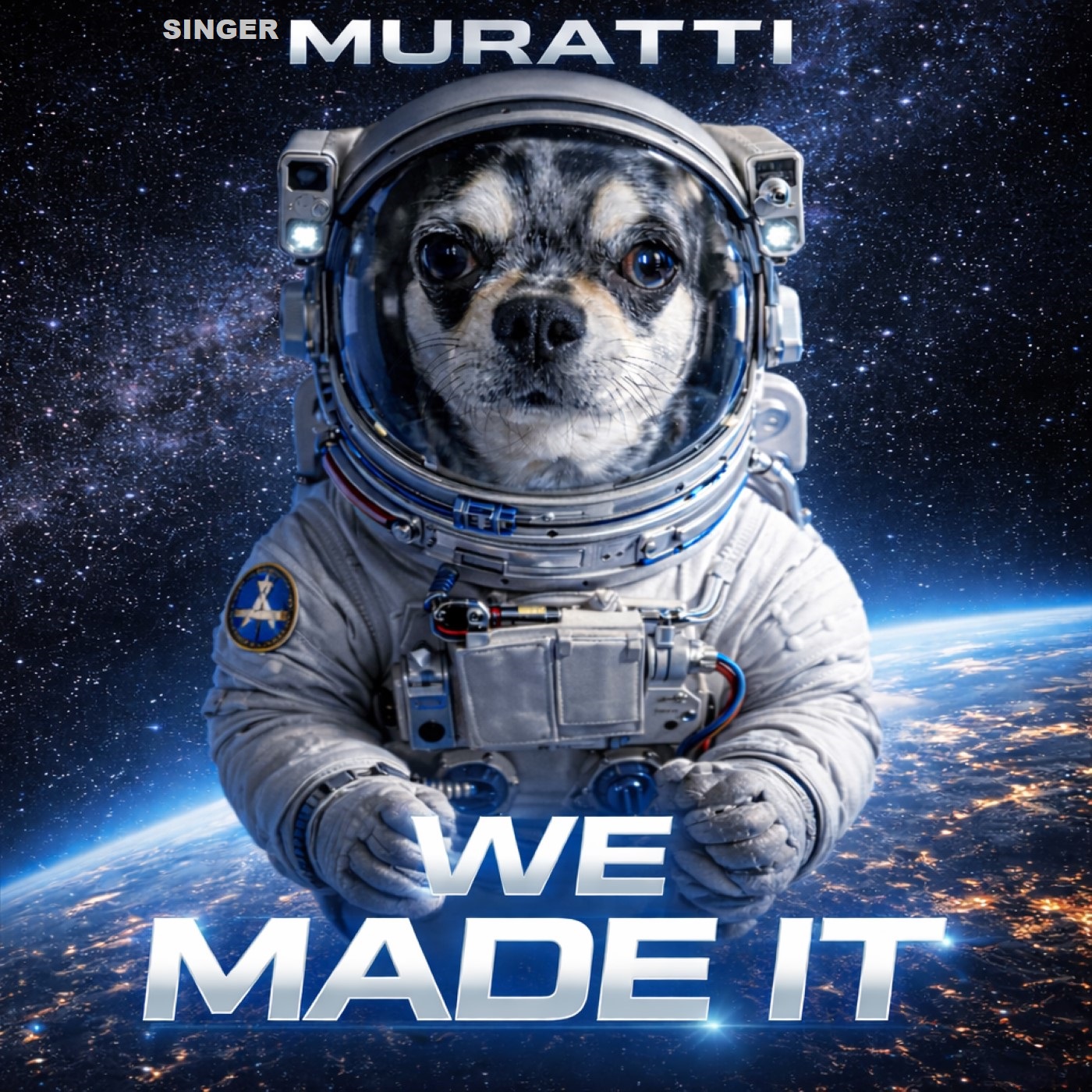

There’s a certain kind of electronic release that doesn’t rush to impress, that instead unfolds slowly, almost cautiously, before revealing its full emotional weight. “We Made It” by Singer Muratti sits comfortably in that space. At first glance, it leans into familiar synthpop territory—glossy textures, steady pulse, melodic clarity—but there’s something else underneath, something slightly worn at the edges, like a memory revisited too many times to remain pristine.
The track opens with a restrained piano motif, simple and reflective, carrying a faint cinematic hue. It doesn’t try to dominate the mix; rather, it sets a tone—introspective, slightly distant. Then the rhythmic framework begins to take shape. The beat is clean, anchored in EDM structure, yet it avoids the typical over-compression often associated with the genre. Instead, it breathes. The kick lands firmly but without aggression, while the hi-hats and percussive layers glide in with a kind of understated precision. There’s a patience to the rhythm that allows the arrangement to evolve naturally.
What stands out in the production is the layering of synths. They arrive gradually, almost imperceptibly at first, then begin stacking into a wider, more enveloping soundscape. Some patches feel intentionally retro—soft pads with a faint analog warmth—while others push forward with a sharper, more contemporary edge. This contrast creates a tension between past and present, which seems central to the track’s identity. It never fully commits to nostalgia, nor does it abandon it.
Muratti’s vocal performance carries much of the emotional weight. There’s a controlled vulnerability in the delivery, something that doesn’t rely on dramatic flourishes but instead lingers in the phrasing. His background in classical training becomes evident in the way he handles dynamics—subtle shifts, careful modulation, never overextending. At times, the voice feels almost detached, as if observing the story from a slight distance; at others, it pulls closer, more immediate, more personal. That fluctuation works in favor of the song’s thematic core.
As the track progresses, the structure mirrors the fragmented nature of memory. Verses feel like snapshots rather than complete narratives, small images stitched together without forcing cohesion. Then the chorus arrives, broader and more declarative. The synths expand, the rhythm tightens, and the emotional tone shifts toward something more resolute. It’s not purely triumphant, though—it carries a trace of melancholy, as if acknowledging that reaching a destination doesn’t erase what’s been left behind.
The interplay between atmosphere and rhythm is particularly effective here. While the track is clearly rooted in EDM and synthpop conventions, it resists becoming purely functional dance music. There’s enough drive to imagine it within a live set, yet the atmospheric layers—those lingering pads, the echoing melodic fragments—anchor it in a more reflective listening experience. It exists somewhere between movement and stillness, never fully settling into either.
Production-wise, the collaboration brings a sense of cohesion without over-polishing the final result. There are moments where the mix feels intentionally imperfect—slight roughness in transitions, or synth layers that overlap just enough to blur their edges. Rather than detracting, these choices add character, reinforcing the track’s emotional ambiguity.
“We Made It” ultimately feels like a closing statement shaped with intention. It doesn’t attempt to redefine the genre, nor does it rely on novelty. Instead, it focuses on tone, memory, and atmosphere, building a piece that resonates more through accumulation than immediate impact. It’s a release that rewards attentive listening, revealing its nuances gradually, almost reluctantly.
There’s a quiet confidence in that approach, and it’s precisely what makes the track linger long after it ends.