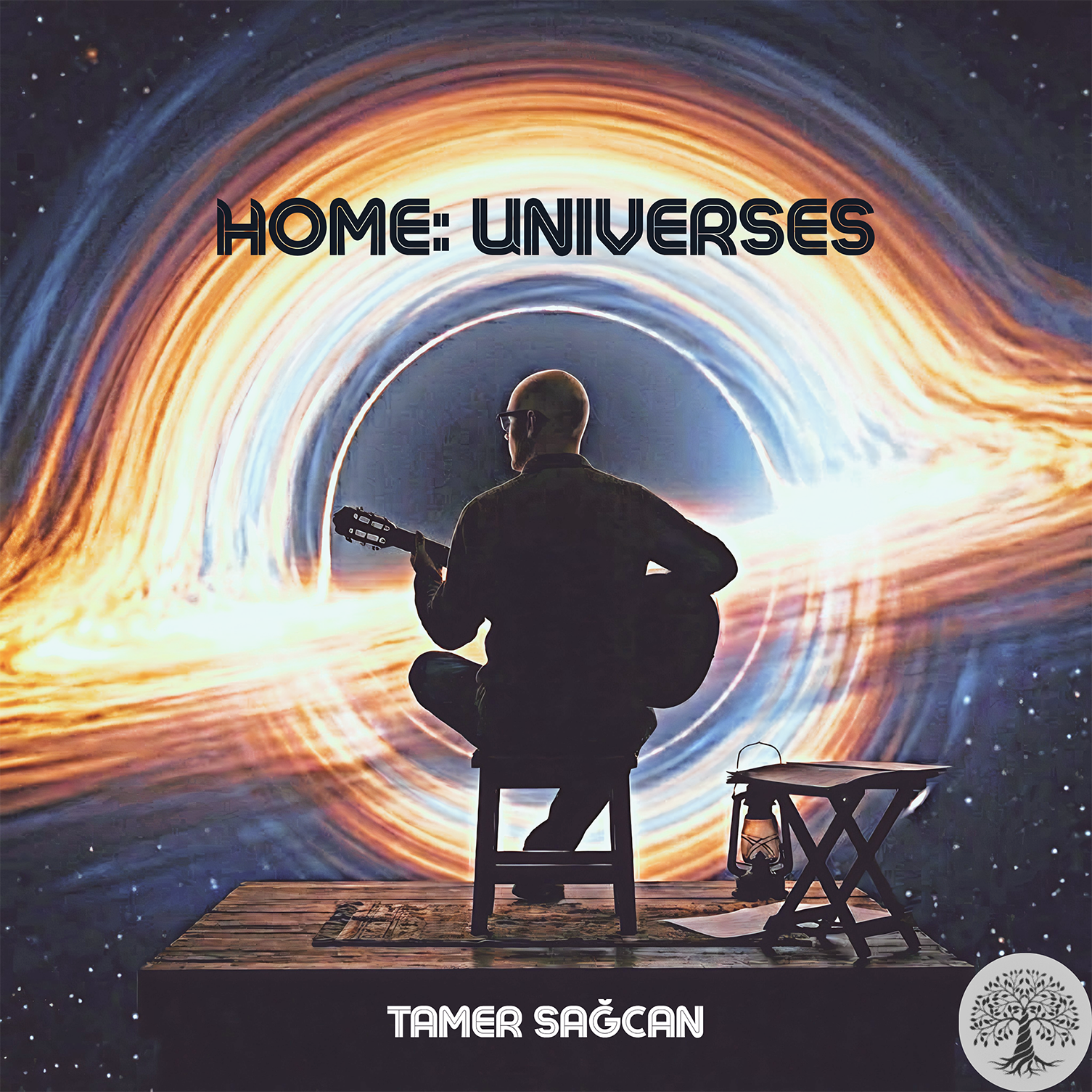

Home: Universes arrives as the second movement in Tamer Sağcan’s ongoing Home Trilogy, pushing the project outward from intimacy into something more expansive, almost gravitational in scope. What was once rooted in personal memory now drifts into cosmological abstraction, where classical guitar remains the anchor point but is increasingly surrounded by layered orchestration, ambient pressure systems, and slow-burning electronic textures. The result is a record that feels less like a collection of tracks and more like a continuous field of sound, subtly shifting its internal weather.
Across the album, rhythm is treated with restraint rather than propulsion. Beats rarely assert themselves in a traditional sense; instead, they emerge as pulses, faint structures hidden beneath pads and reverberating guitar phrases. In pieces like “Event Horizon” and “Enterstellar,” percussive elements are almost subliminal, more implied than stated, giving the impression of movement without urgency. Even when the dynamic range expands, the tempo refuses to rush forward. This controlled pacing allows the listener to inhabit each sonic space fully, where silence and decay are as important as any melodic line.
The synth work is central to the album’s identity, often operating as a second narrative layer. Rather than dominating the arrangements, synthesizers behave like atmospheric architecture: long-form drones, filtered harmonic swells, and soft granular textures that blur the edges of the compositions. In “Materia Oscura,” the low-end synth presence darkens the entire frame, while higher frequencies flicker like distant signals. “Singularity,” positioned as the emotional centerpiece, combines these synthetic elements with more defined melodic contours, allowing tension and release to coexist without resolution. The neoclassical influence remains visible, but it is constantly refracted through ambient and cinematic processing.
Sağcan’s use of classical guitar prevents the album from dissolving entirely into abstraction. The instrument functions as both compositional spine and emotional signal. In tracks such as “Eridanus” and “Laniakea,” fingerpicked motifs surface through dense orchestration, briefly clarifying the harmonic direction before fading back into layered textures. Elsewhere, in “Entropy,” the maqam-inspired phrasing introduces microtonal inflections that subtly disrupt Western harmonic expectations. “Vis Viva” and “Aeterna” lean into flamenco-influenced articulation, adding rhythmic tension through string attack rather than percussion, creating momentum that feels organic rather than engineered.
The overall atmosphere of Home: Universes is carefully balanced between vastness and intimacy. Even at its most cinematic, the album resists spectacle for its own sake. Instead, it constructs a series of controlled emotional environments, each track acting like a chamber within a larger imagined cosmology. The influence of Sağcan’s broader Eleyrrha Universe is present but never overbearing; references to myth and structure remain embedded within the sound rather than explained through it. This reinforces the sense that the listener is moving through a system of ideas rather than being guided through a linear narrative.
As a listening experience, the album rewards patience. Details surface gradually: a delayed reverb tail, a secondary melodic phrase buried under harmonic haze, or a subtle rhythmic displacement that shifts perception without announcing itself. The production leans into depth over immediacy, allowing repeated listens to reveal additional layers of intention. At no point does the record demand attention aggressively; it holds it through atmosphere, coherence, and carefully controlled variation.
Home: Universes stands as a well-constructed and thoughtfully executed release within contemporary ambient and chillwave-adjacent composition. Its synthesis of classical guitar, neoclassical structure, cinematic ambience, and synthetic expansion results in a cohesive sonic language that remains consistent across thirteen tracks while still allowing individual identities to emerge. It is a release of high quality that we are glad to host on our webzine with this review, not as a conclusion, but as an entry point into a larger unfolding system of sound and narrative still in motion.