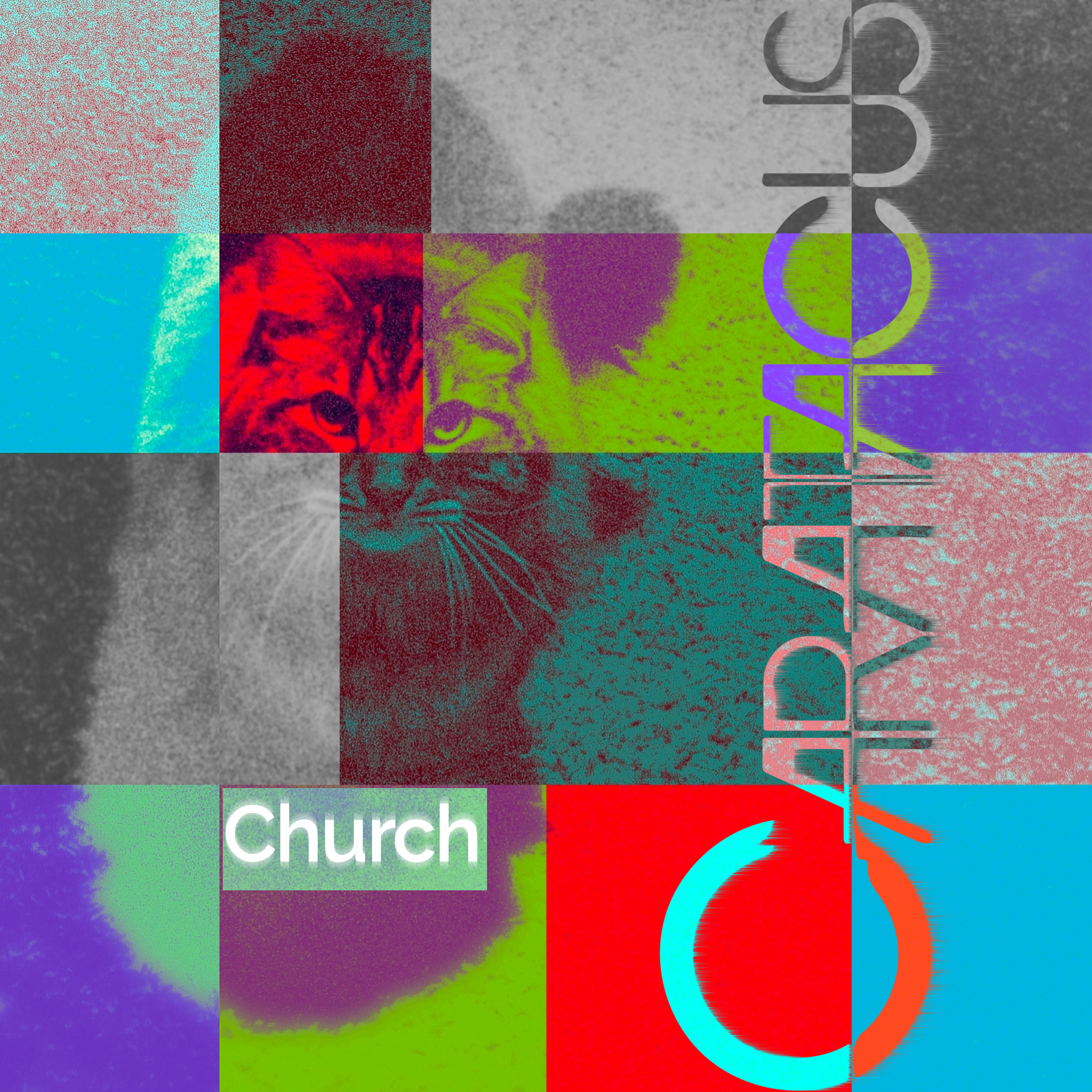

A dim cinematic pulse runs through Church, the latest full-length release from Caratacus, an artist whose relationship with narrative feels inseparable from sound itself. Framed as an instrumental concept album following the perspective of a cat drifting through a spacecraft in crisis, the record unfolds less like a conventional ambient release and more like an unspoken science-fiction score, suspended somewhere between isolation, curiosity, and mechanical decay. The absence of lyrics never leaves a void. Instead, every synth texture, rhythmic fragment, and layer of static behaves like dialogue.
Built entirely by Caratacus — from composition to visual artwork — Church leans heavily into downtempo and ambient structures while borrowing emotional language from film scores, progressive rock, and retro-futuristic electronic music. The influence of classic sci-fi cinema is unmistakable. Echoes of Alien, Moon, and even older analog-era soundtracks drift beneath the surface, though the album avoids becoming overly nostalgic or derivative. It feels modern in construction but emotionally tied to an earlier imagination of space travel, one shaped by blinking control panels, cold corridors, and lonely observation windows.
The rhythmic approach across the record deserves particular attention. Rather than relying on dominant percussion or dance-oriented momentum, Caratacus uses rhythm as environmental movement. Many of the drum patterns arrive in restrained forms: soft kicks buried beneath haze, fractured clicks resembling ship machinery, muted snares dissolving into reverb before they fully settle. This creates a floating sensation throughout the album, as if the listener is moving through sections of a vessel without gravity ever fully stabilizing. At times the beats barely hold together, and that instability becomes part of the emotional architecture.
The synth work carries the narrative weight. Warm analog-style pads sit beside brittle digital tones, while oscillators hum underneath tracks like distant engines powering an exhausted spacecraft. Several passages feel intentionally cluttered with electronic debris — static bursts, filtered pulses, mechanical beeps — but the production remains remarkably controlled. Even in its densest moments, the album preserves clarity and atmosphere. Caratacus understands restraint. Melodies often emerge slowly, almost hidden within the mix, before disappearing again without resolution.
What makes Church particularly engaging is its ability to maintain emotional ambiguity. The album constantly shifts between comfort and unease. One track may suggest wonder and childlike curiosity, while the next introduces tension through dissonant synth swells or suffocating low-end drones. That balance gives the project a cinematic quality rarely achieved in purely instrumental electronic records. It never sounds like background music designed to disappear completely, even if it functions beautifully in passive listening environments.
“Reactor Chamber (I Lurk For You)” stands out as one of the strongest moments on the release. The track carries the atmosphere of an old monster film translated into digital language. Pulsing low frequencies and uneasy synth harmonics create a sense of lurking danger, yet underneath the darkness sits an unexpected emotional vulnerability. The composition slowly reveals something closer to longing than fear, and that contradiction gives the piece unusual depth.
On the other side of the emotional spectrum, “Hours Wasted Lovingly” introduces a softer and strangely familiar atmosphere. The pacing relaxes, the melodic phrasing opens slightly, and the surrounding textures become gentler without abandoning the album’s overarching tension. It captures a difficult feeling to articulate — something close to ordinary happiness observed from a distance. Not euphoric, not tragic, simply human in its stillness.
The production itself reinforces the intimacy of the project. Recorded primarily in a small apartment bedroom during sleepless nights, the album never hides its solitary origins. That isolation becomes part of its identity. The music feels handcrafted rather than engineered for algorithmic precision, and small imperfections in transitions or texture layering only strengthen its atmosphere. Caratacus also embraces his affection for video game music without apology, allowing simple wave generators and classic electronic timbres to shape the album’s sonic fingerprint.
Church succeeds because it commits fully to its concept without becoming trapped by it. Even listeners uninterested in the narrative of a cat wandering through a failing spacecraft can appreciate the album purely for its sound design and immersive pacing. Yet the story remains quietly present in every detail, giving the release a personality many ambient records struggle to achieve. It is an imaginative, carefully constructed body of work — one we are genuinely pleased to feature and explore through our pages.