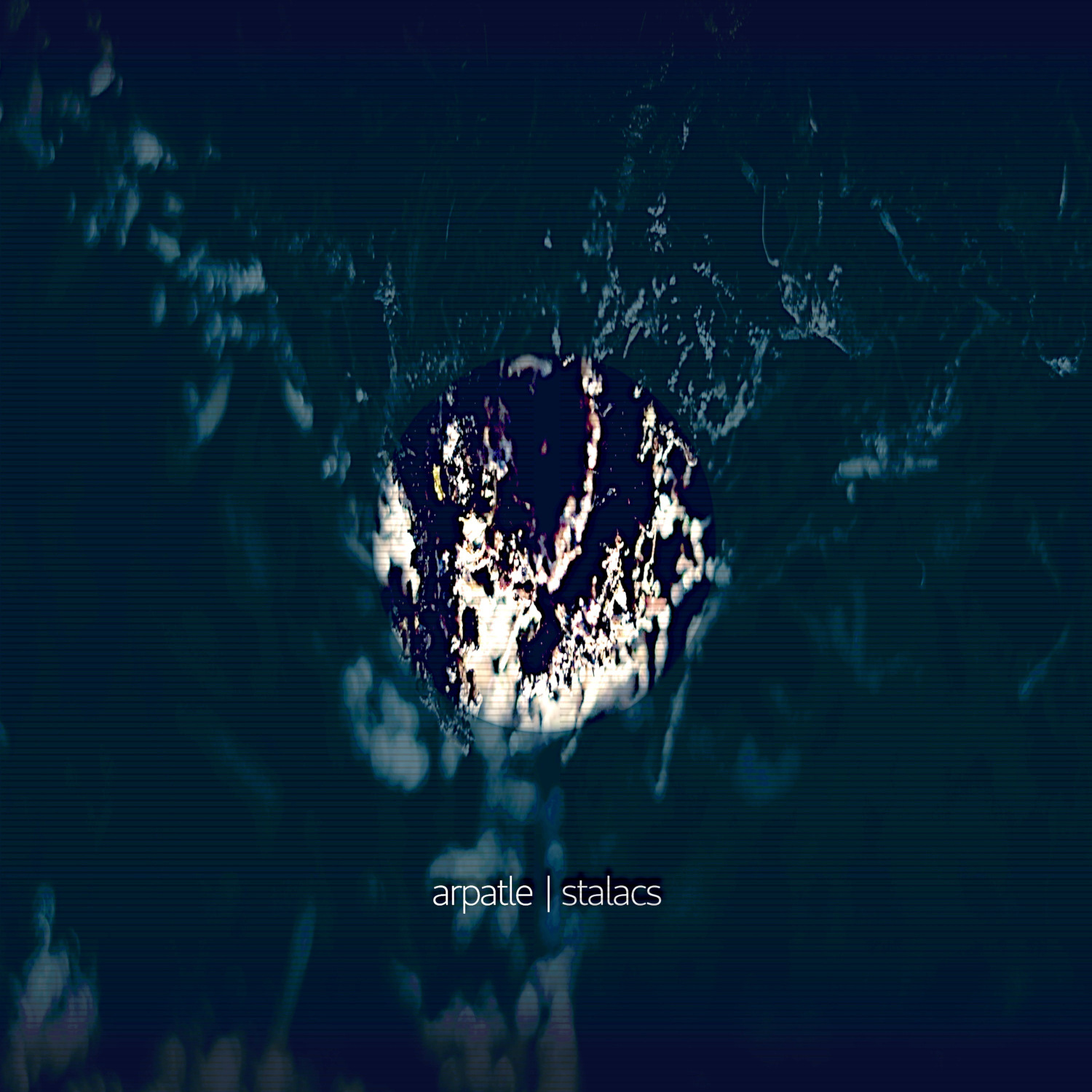

Opening Arpatle’s Stalacs feels less like pressing play and more like entering a sealed acoustic chamber where sound behaves like a physical substance. Across its 28 minutes, the EP unfolds as a tightly controlled experiment in dark ambient and drone, yet it never loses a strangely organic pulse that keeps pulling the listener forward, even when the textures seem to dissolve into near-stasis.
Patrick Bossink, operating under his alias Arpatle from Utrecht, constructs these pieces without leaning on traditional synthesizer architecture. Instead, the material is carved through granular delays, acoustic feedback loops, and unstable recording conditions that deliberately let imperfections surface. The result is a sound world that feels both engineered and eroded at the same time, as if it has been shaped by slow geological pressure rather than studio intention.
The opening track, Mare Serenitatis, sets the conceptual tone immediately. It begins with a dense cluster of 1024 sine tones, which do not so much harmonise as they collide and blur into a luminous fog. Out of this mass, a subtle rhythmic presence emerges — not a beat in the conventional sense, but a recurring tick-like articulation that functions like a biological marker. It is faint, but persistent enough to suggest a heartbeat buried under layers of sediment. The rhythm never fully resolves, instead hovering in a suspended loop that feels both infinite and constrained.
That idea of hidden pulse continues throughout the EP. Every track contains some form of repetition: a barely audible click, a low resonant thump, or a slow oscillation that resurfaces at irregular intervals. These elements give Stalacs a paradoxical structure. On one hand, the compositions feel formless; on the other, they are anchored by micro-patterns that act like gravitational points. The listening experience becomes an exercise in attention, where the smallest rhythmic artifact starts to feel disproportionately significant.
Aurora Stalactis expands the palette with colder, more vertical textures. The synth layers here are less about density and more about spatial decay. High frequencies shimmer like distant metallic dust, while lower drones shift with a slow instability that suggests physical movement inside a cavern. The track’s rhythmic element is nearly subliminal, resembling water drops hitting stone at uneven intervals. Rather than building tension, it sustains a slow state of suspension, where every sound feels delayed in its own echo.
The third piece, Cavenon, introduces a more intrusive human presence through heavily processed vocal material. Extended delays stretch the voice into elongated spectral trails, recalling experimental tape techniques associated with James Tenney’s Saxony. Yet the recording process itself becomes part of the composition: unintended feedback tones seep into the mix, and a subdued melodica line occasionally surfaces, almost apologetic in its appearance. These imperfections do not disrupt the atmosphere; instead, they deepen it, adding a layer of fragility beneath the otherwise controlled sonic environment.
Closing track Ignit moves toward a more abstracted resolution. It does not conclude the EP in a traditional sense but rather disperses it. The rhythmic traces that previously acted as anchors begin to fragment, leaving behind only scattered sonic debris. The synth work here feels increasingly gaseous, with tones dissolving before they can fully establish identity. What remains is a kind of afterimage — not silence, but the suggestion that sound has recently passed through and is still fading.
Across Stalacs, rhythm is never absent, but it is consistently destabilised. Synths do not build melodies; they accumulate atmospheric pressure. The overall sonic architecture leans toward erosion rather than construction, with each track revealing how fragile repetition can become when stretched across minimal forms.
As a cohesive release, Stalacs stands as a carefully sculpted piece of sonic experimentation that maintains clarity even in its most abstract passages. It is a work that rewards patient listening, where small details gradually reshape the perception of the whole. For a project rooted in controlled instability and subtle acoustic intervention, Arpatle delivers a focused and consistent statement that fits comfortably within contemporary dark ambient and drone discourse, while still retaining a distinct personal imprint.