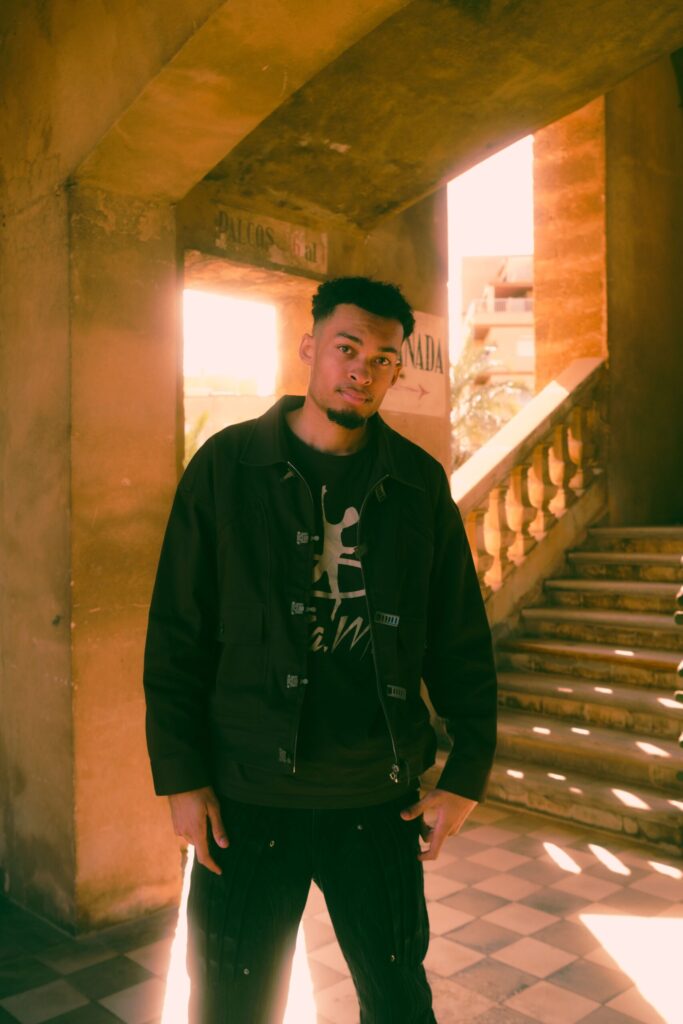
Arriving after a noticeable period of silence, “Interspace” marks Janger’s return to electronic music with a sharpened sense of direction. The Los Angeles-based producer, known for blending club-driven energy with experimental sensibilities from his CalArts background, delivers a track that sits between EDM and house without settling fully into either lane. Built for late-night listening but structured with a clear club functionality, the release feels intentional in every layer. Rather than relying on immediacy alone, it unfolds gradually, revealing texture and weight as it progresses, suggesting an artist re-entering the scene with patience rather than urgency now.
Pulsing percussion defines the backbone of “Interspace,” where Janger builds a rhythmic structure that feels both restrained and forward-driving. The kick pattern is clean but slightly compressed, leaving enough space for syncopated hi-hats that shift subtly across the stereo field. Rather than leaning into heavy drops, the track maintains a rolling groove that prioritizes continuity over shock. Small rhythmic variations appear in looping patterns, almost imperceptible at first listen, but they accumulate into a sense of motion that never fully resolves. This approach reflects a producer more interested in sustained energy than predictable climaxes, keeping the listener locked into a steady but evolving pulse that gradually intensifies over extended time.
Across its synth architecture, “Interspace” leans into a layered approach where analog-style warmth collides with digital precision. Pads stretch wide, forming a hazy harmonic bed that supports the track without overwhelming it. Lead synths cut through with a slightly detuned edge, giving the melodic fragments a human imperfection that contrasts the otherwise clean production. There is a subtle grain in the mid frequencies, as if the sound has been lightly degraded to preserve texture. Transitions are handled with filtered sweeps and restrained risers rather than dramatic build-ups, reinforcing the track’s focus on continuity. Every sonic element feels placed with intention, leaving negative space that enhances clarity and depth in the mix. A sense of controlled experimentation runs throughout, yet nothing feels excessive or disconnected from the core groove of the track.
The atmosphere of “Interspace” carries a distinct late-night tension, balancing euphoric release with a gritty undercurrent that never fully disappears. Janger frames the track in a space that feels both nostalgic and forward-facing, where emotional resonance is carried through texture rather than overt melodic statements. The recognizable vocal fragment associated with Underworld’s “Born Slippy” appears woven into the arrangement, not as a dominant hook but as a spectral reference that anchors the track in electronic music history. Around it, reverberated layers and subtle delays create a sense of distance, as if the sound is constantly moving through a large undefined space. The result is immersive without being overwhelming, drawing the listener inward rather than pushing outward.
Janger’s return with “Interspace” also carries weight when placed against his broader trajectory as a producer emerging from Los Angeles’ electronic scene. Early releases such as “Make Em Dance” and “Move It Down” established his presence through algorithmic visibility and editorial playlist support, while “Groovin’” expanded his reach internationally with strong streaming performance and DJ backing. After a deliberate five-year silence dedicated to study within the Experimental Pop program at CalArts, this new chapter signals a recalibrated artistic direction. The selection of the track by John Tejada for Touched Music’s Future Stars 7 compilation further positions the release within a lineage of forward-thinking electronic curation, reinforcing its understated credibility. The track has also begun to gain international attention through press coverage in Turkey and radio support in France, adding an unexpected geographical spread to its early reception.
What emerges is a sense of controlled escalation rather than immediate payoff. The track does not rely on conventional peak-time structures, instead choosing to build its identity through repetition and micro-evolution. This approach gives “Interspace” a hypnotic quality, where the listener becomes gradually absorbed into its internal rhythm rather than being pushed toward a defined climax. It is in this slow accumulation that Janger’s production choices become more evident, especially in how he balances density and air within the mix.
There is also a clear emotional undercurrent running beneath the surface. While the surface-level energy suggests club functionality, the deeper layers feel more introspective, almost reflective in tone. The vocal fragment borrowed from Underworld’s legacy acts as a connective thread between eras of electronic music, but in this context it is treated less as nostalgia and more as material to be reinterpreted. It appears fractured, recontextualized, and embedded into a different rhythmic logic that reshapes its meaning entirely.
From a production standpoint, the mixdown prioritizes clarity without sacrificing atmosphere. Low-end elements remain tight and controlled, allowing the groove to stay present without overpowering the midrange detail. The synth layering avoids overcrowding, instead favoring careful placement of elements that enter and exit the arrangement with purpose. Even in more saturated moments, there is a sense of discipline guiding the overall structure, as if every sound has been evaluated not only for impact but for necessity.
As a comeback statement, “Interspace” also carries contextual weight within Janger’s artistic timeline. The years spent away from releasing music appear to have been reinvested into refinement rather than reinvention, and that choice is audible throughout the track. Rather than attempting to radically shift identity, he expands it from within, reinforcing what was already present in his earlier work while tightening its execution. The result is a piece that feels both familiar to long-term listeners and newly precise in its construction.
Within the broader electronic landscape of 2026, “Interspace” sits comfortably in a space where genre boundaries continue to blur. EDM and house are no longer rigid categories here, but flexible frameworks that allow hybrid approaches like this one to exist without friction. Janger operates within that ambiguity with confidence, shaping a sound that is neither purely functional nor purely experimental, but something positioned deliberately between the two.
The final impression is one of coherence and intent. “Interspace” does not attempt to overwhelm or reinvent its surroundings; instead, it refines them, offering a measured but effective return that signals continuity in Janger’s trajectory while opening a clear path forward.