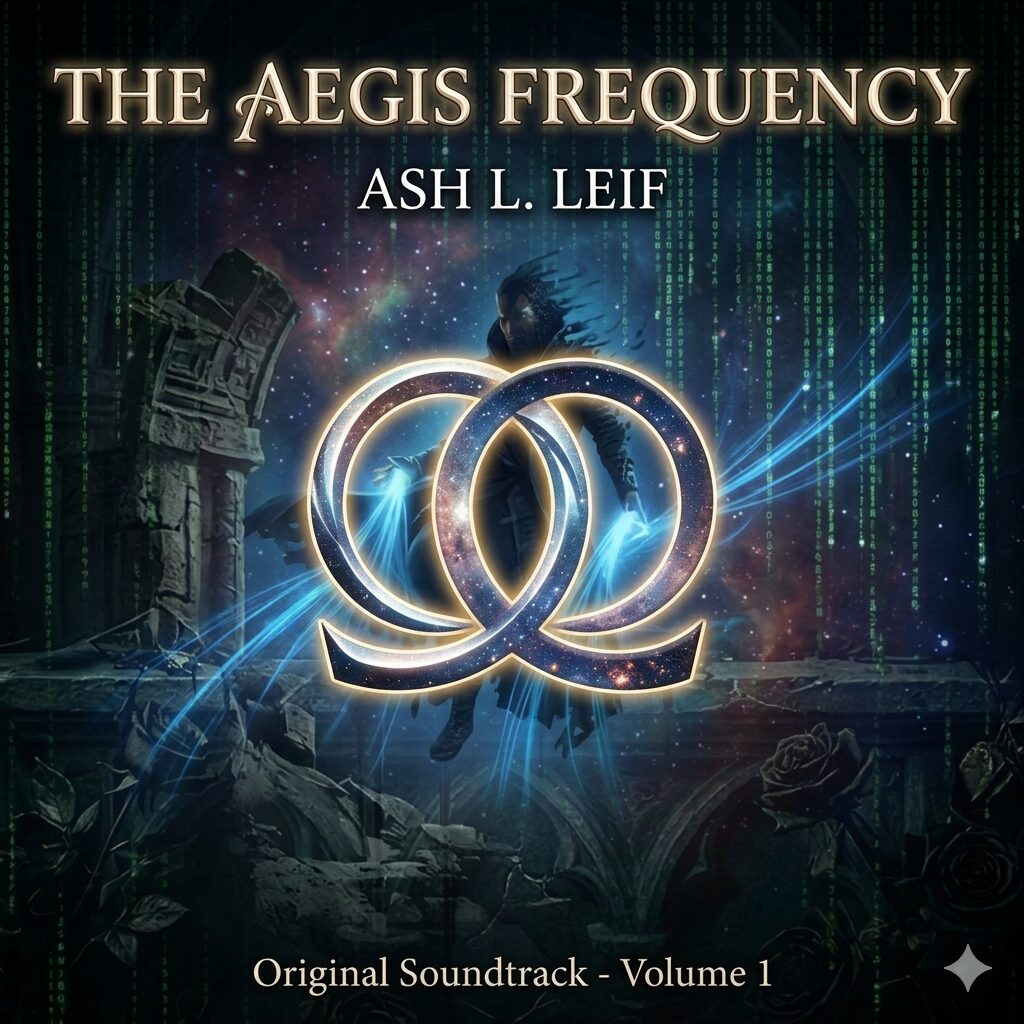

Ash L. Leif approaches “The Aegis Frequency” less like a conventional release and more like an atmosphere you are asked to step inside. Rooted in alternative indie sensibilities but shaped by electronic production, orchestral scale and contemporary R&B influences, the track immediately establishes a cinematic dimension without losing sight of its emotional core. It feels deliberately expansive, yet there is something intimate beneath all that weight, as if the music is carrying a personal confession through an enormous fictional landscape.
The rhythmic architecture is one of the strongest elements of the production. Rather than relying on a static electronic pulse, the track uses heavy, driving beats to create continuous forward movement. The percussion gives the arrangement a sense of purpose, almost like a soundtrack accompanying a character who has already survived the first chapter and is refusing to turn back. There is tension in the groove, but it never becomes unnecessarily aggressive. Instead, the rhythm keeps the track suspended between introspection and confrontation, which suits its theme of resilience particularly well.
The synth work adds another important layer to this equation. Digital textures give the production its darker identity, surrounding the central musical ideas with an electronic haze that feels both contemporary and slightly otherworldly. Ash L. Leif’s digital-first approach is evident in the precision of these sounds, although the arrangement avoids the sterile quality that can sometimes accompany heavily programmed music. Synths become part of the storytelling rather than simply decorative elements, widening the sonic perspective and helping transform the song into something closer to a scene than a standalone composition.
Atmosphere, ultimately, is where “The Aegis Frequency” makes its strongest impression. Sweeping orchestral elements coexist with electronic rhythms, creating a contrast between organic grandeur and synthetic darkness. The result has the scale of a fantasy score but retains the emotional language of alternative music. It is easy to imagine these sounds accompanying a decisive moment in a film or game, yet the track does not feel trapped inside that imagery. There is enough ambiguity in the production for the listener to attach their own meaning to it.
That cinematic quality becomes even more interesting when considered alongside The Omega Saga, the wider dark-fantasy universe created by Ash L. Leif. The music is presented as a “living soundtrack”, and that concept makes sense here. The Aegis Frequency is not simply attempting to describe a fictional world; it is designed to extend that world through sound. The idea could easily become overly conceptual, but the production gives it a tangible emotional foundation. The sense of defiance running through the release feels audible before any narrative context is required.
There is also a welcome balance between scale and vulnerability. “I’m Still Right Here”, the anchor single connected to the release, reinforces the project’s central idea of persistence in the face of overwhelming forces. Its emotional message does not need to be overstated because the arrangement already communicates a certain stubbornness: the rhythm keeps pushing, the synth layers remain present, and the orchestral passages continuously suggest something larger waiting beyond the immediate frame.
What makes The Aegis Frequency particularly compelling is the willingness to operate between categories. Alternative indie, electronic rock, dark contemporary R&B and cinematic composition all leave traces here, but none completely defines the experience. Ash L. Leif seems more interested in constructing an emotional universe than satisfying a genre formula, and that gives the release room to breathe.
For our part, this is exactly the kind of ambitious independent production we are happy to host on Parkett Channel. The Aegis Frequency has genuine sonic personality, a clear artistic concept and enough textural depth to reward repeated listening. It feels like one chapter of something considerably larger, but crucially, it also works on its own terms. A dark, atmospheric and carefully constructed release, it demonstrates how electronic production can become part of a broader narrative without sacrificing musical identity.