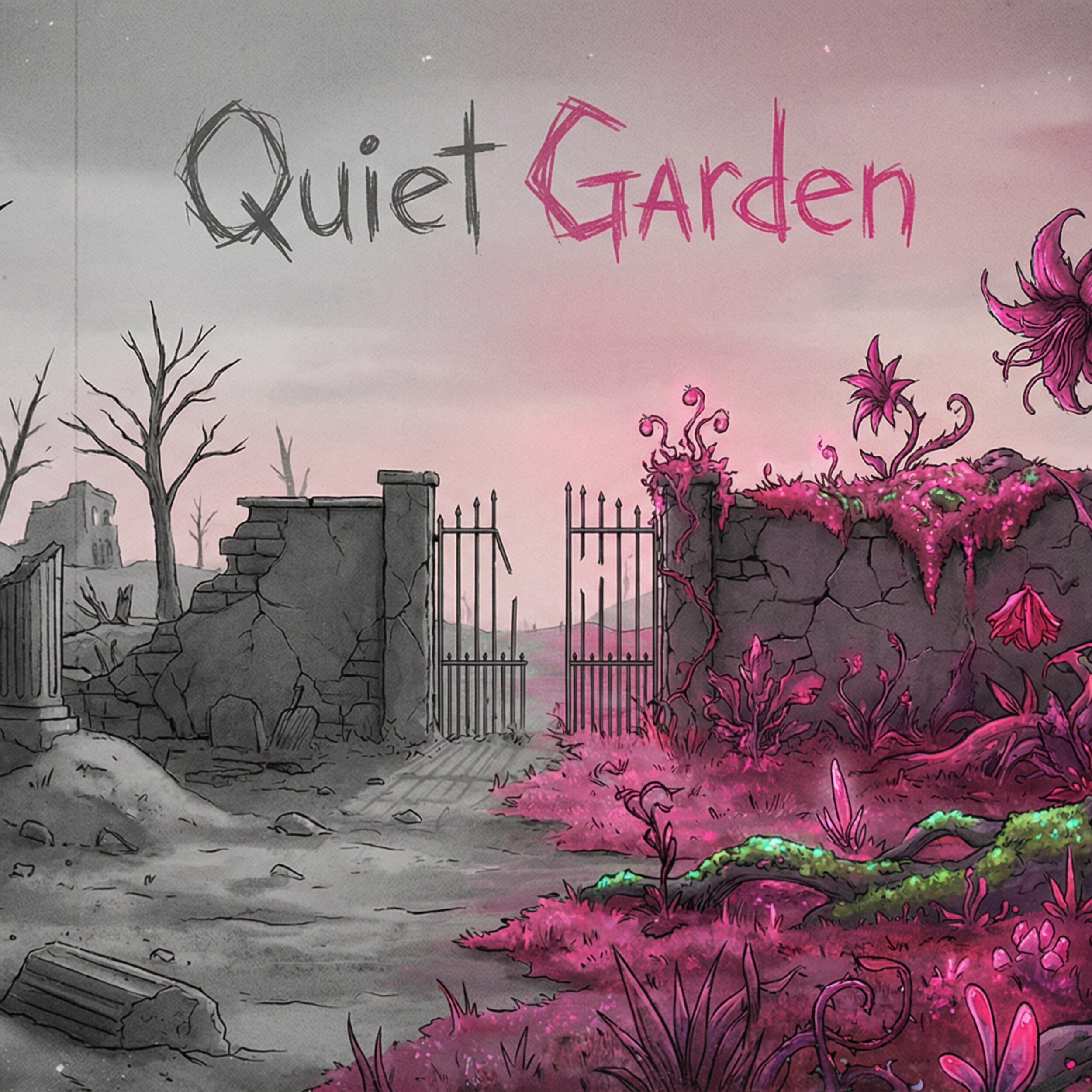

Garbage Garden’s “Quiet Garden” unfolds like a carefully fractured memory, one that resists linear interpretation while inviting a deeply personal response. Rooted in experimental electronic music yet brushing against pop sensibilities and drum and bass undercurrents, the track introduces the “Still Being” series with a sense of quiet urgency. It doesn’t announce itself loudly; instead, it seeps in, gradually revealing a layered architecture of sound and meaning that lingers long after the final note dissolves.
Rhythmically, the piece operates in a space that feels both controlled and unstable. The drum patterns borrow from drum and bass traditions, but they are stripped of predictable momentum, often breaking just as they begin to settle. This creates a subtle tension—an off-balance pulse that mirrors the thematic exploration of presence and absence. The percussion never dominates; it flickers in and out, suggesting motion without ever fully committing to propulsion. In some passages, the beat feels almost hesitant, as if aware of its own fragility.
The synth work is where “Quiet Garden” truly establishes its identity. Glitch-infused textures ripple across the mix, sometimes sharp and digital, other times softened into something more cinematic. These layers don’t simply decorate the composition; they carry its emotional weight. Melodic fragments emerge like distant signals, briefly coalescing into something recognizable before dissolving again into abstraction. There’s a deliberate imbalance between clarity and distortion, a push-and-pull that keeps the listener slightly disoriented—in a compelling way.
Atmospherically, the track leans into a kind of restrained haunting. It doesn’t rely on overt darkness but instead builds a space that feels suspended, almost weightless. The “garden” of the title is not serene in a traditional sense; it is quiet in a way that amplifies every subtle movement, every hidden noise. This sonic environment reflects the core narrative: the invisible labor, the unseen presence of those who sustain others without acknowledgment. The sound design captures this paradox beautifully—what is absent feels just as significant as what is present.
Vocally and lyrically, the song operates with a poetic ambiguity that enhances its emotional resonance. Lines like “The closer I stand, the more I disappear” encapsulate the central tension without over-explaining it. There is an intentional openness here, a refusal to anchor the listener to a single interpretation. Instead, the track acts as a reflective surface, allowing individual experiences to shape its meaning. This approach aligns with the project’s broader thematic focus on existence and relationships in a digitized, often alienating world.
The production quality is notably refined, yet it avoids the sterility that can sometimes accompany high-end electronic music. There are small imperfections—textural inconsistencies, slight asymmetries in the mix—that give the track a human edge. These details feel purposeful, reinforcing the idea of something living beneath the digital exterior. The collaboration with co-producer Peachoman appears to have expanded the track’s scope, transforming it from a personal narrative into something more universal without losing its intimacy.
What stands out most is the balance between playfulness and sincerity. Despite its heavy conceptual framework, “Quiet Garden” never feels overly burdened by its own ideas. There’s a lightness in the way elements are introduced and withdrawn, a sense of exploration that keeps the listening experience engaging. At times, the track even hints at accessibility, brushing against pop structures before veering away again into more experimental territory.
As an opening statement for the “Still Being” series, this release sets a high standard. It signals a shift toward a more existential exploration while maintaining the project’s signature contrast between intricate soundscapes and human-centered narratives. The result is a piece that feels both introspective and outward-looking, grounded yet elusive.
“Quiet Garden” is, ultimately, a carefully constructed contradiction: intimate yet distant, structured yet fluid, quiet yet resonant. It’s the kind of release that rewards repeated listens, each pass revealing new details, new interpretations. High-quality in both concept and execution, it stands as a compelling addition to the evolving landscape of experimental electronic music—and a release we are genuinely pleased to feature and examine within our pages.