

With Stupid Games, Kitbuilders return with a release that feels both archival and immediate, carefully stitching together different phases of their long-standing trajectory into a single, cohesive statement. The Cologne-based duo—singer Ripley and keyboardist Benway—have always operated in a space where electro, new wave, and IDM overlap without fully settling into any one category. This album reinforces that identity, offering a body of work that reflects continuity rather than nostalgia, evolution rather than revival.
The rhythmic foundation of Stupid Games is one of its defining traits. Beats are direct and punchy, often built around classic electro structures, yet subtly destabilized through timing shifts, syncopated accents, and restrained use of distortion. There is a mechanical insistence to many of the tracks, but it never becomes rigid. Instead, the rhythms breathe, sometimes feeling deliberately underplayed, sometimes snapping sharply into focus. This balance allows the album to move fluidly between dancefloor-ready moments and more introspective passages, without drawing a hard line between function and mood.
Synth work across the record carries much of its emotional weight. Analog tones dominate, ranging from cold, metallic sequences to warmer, slightly detuned lines that feel worn in rather than polished. The influence of early electronic pioneers—often associated with minimalism and confrontation—is evident, yet filtered through decades of refinement. Rather than foregrounding virtuosity, the synths operate as textural tools, shaping atmosphere as much as melody. In tracks like “Tenderness” and “Dark Angels,” the interplay between lead lines and background pulses creates a sense of tension that never fully resolves, giving the music a quietly restless character.
Vocals play a crucial role in defining the album’s personality. Ripley’s delivery is expressive but controlled, shifting between detached phrasing and more urgent, almost confrontational tones. The vocals are rarely treated as a purely narrative element; instead, they function as another rhythmic and textural layer. At times they cut sharply through the mix, at others they sit back, partially obscured, reinforcing the album’s recurring sense of ambiguity. This approach aligns with the lyrical themes suggested by the title Stupid Games: cycles of attraction and resistance, repetition, and the subtle frustrations embedded in human and digital interactions alike.
Atmospherically, the album moves through darker shades without becoming oppressive. There is a persistent sense of nocturnal space—urban, synthetic, slightly claustrophobic—yet moments of melodic clarity prevent the sound from collapsing inward. Tracks such as “Slow Device” and “Follow Me (Concrete Version)” emphasize this duality, pairing stark rhythmic frameworks with melodic fragments that hint at vulnerability. The result is music that feels emotionally charged without resorting to overt dramatization.
The structure of the release itself adds another layer to its identity. By combining remastered material from different eras with new and previously unreleased tracks, Stupid Games functions as a curated journey through the Kitbuilders archive. Rather than feeling fragmented, the sequencing highlights how consistent their core aesthetic has remained since the late 1990s. Even the bonus material and alternate versions contribute to this sense of continuity, revealing subtle variations rather than radical departures.
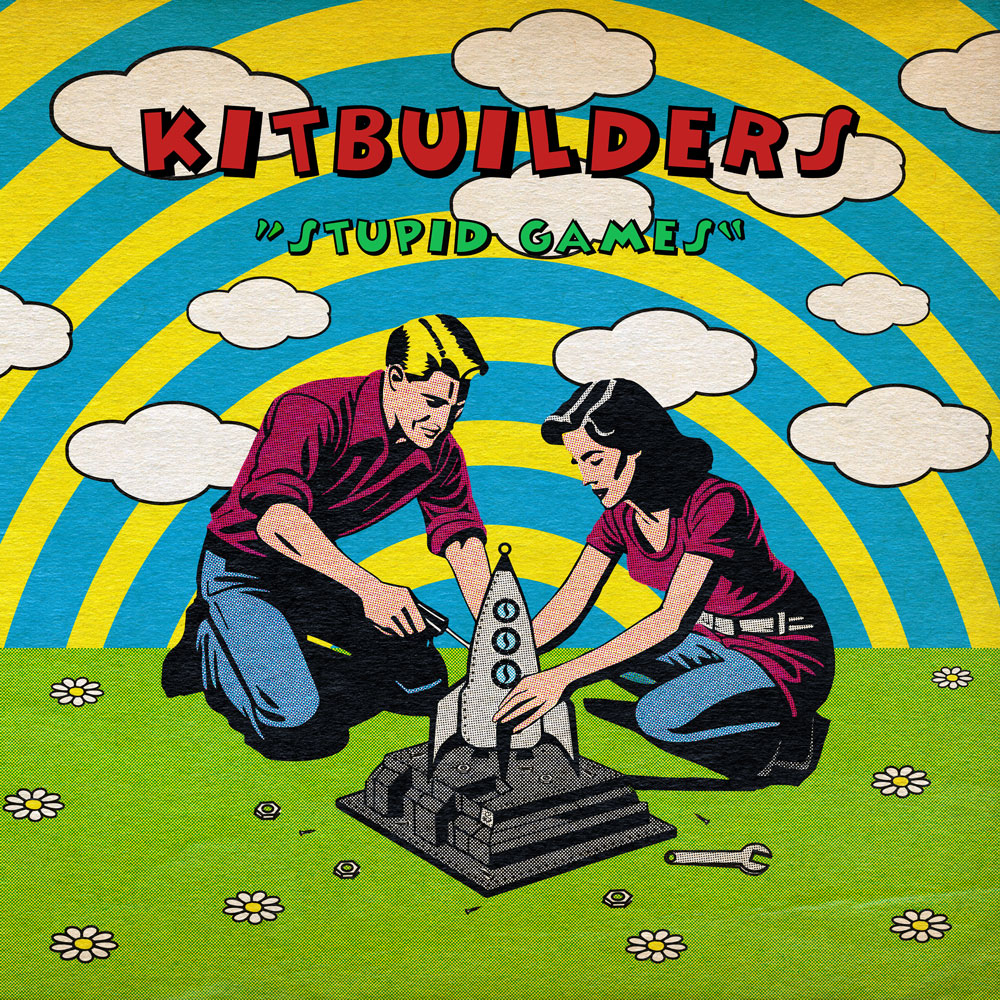
Visually, the artwork by David H. Sekulla complements the album’s sonic character, reinforcing its blend of sharp edges and playful abstraction. It frames the release as something deliberately crafted, aware of its context within both underground electronic culture and contemporary presentation.
Overall, Stupid Games stands as a high-quality release that underscores Kitbuilders’ enduring relevance. It captures the duo’s ability to merge raw electro energy with refined production choices, maintaining tension between past and present. For listeners familiar with their history, the album offers depth and perspective; for new audiences, it provides a clear entry point into a sound shaped by experience, intent, and a refusal to smooth out its rougher edges. It is a release we are genuinely pleased to host on our webzine, marking another confident chapter in the ongoing narrative of Kitbuilders.