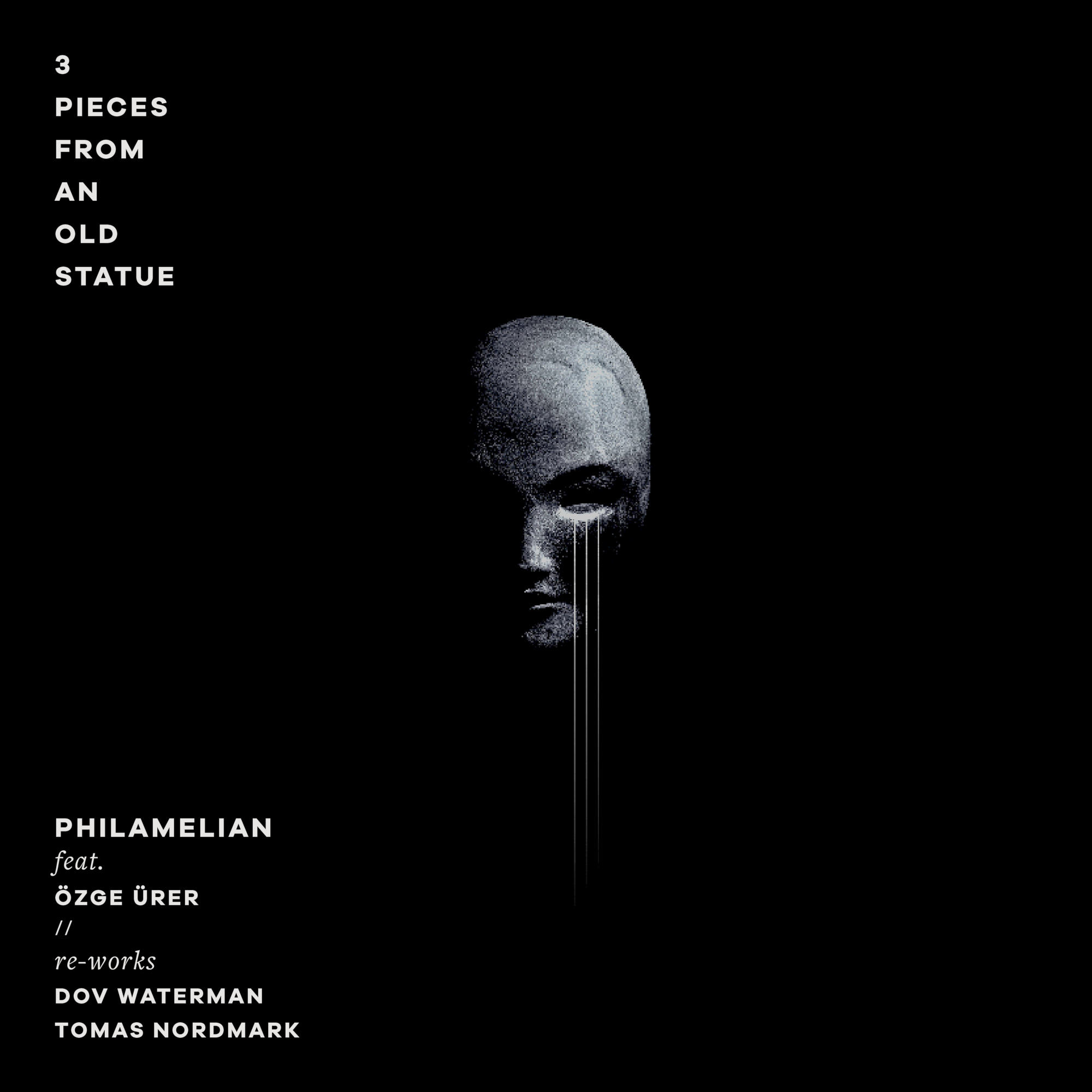

Shifting between classical restraint and electronic abstraction, Philamelian’s 3 Pieces From An Old Statue unfolds as a quietly intricate EP that resists easy categorisation. Built around the compositional identity of Çağrı Tozluoğlu, the release operates in a liminal space where ambient music, downtempo pulse, and IDM-inflected detailing converge without ever fully settling into one fixed shape. The result is a listening experience that feels sculpted rather than arranged, as if each track has been chipped away from a larger, unseen form.
The opening piece, An Old Statue Reimagined, immediately establishes the EP’s tonal grammar. A slow-moving harmonic bed is introduced through layered synth pads that breathe rather than swell, suggesting an almost organic modulation of timbre. Piano fragments appear intermittently, not as melodic anchors but as reflective gestures, suspended in reverb-heavy space. The rhythmic structure is subtle yet deliberate: a restrained downtempo pulse emerges in faint percussive ticks and softened kick patterns, more implied than declared. Rather than driving the composition forward, the rhythm functions like a pulse beneath stone, suggesting movement without disrupting stillness.
What stands out most is the handling of texture. The synthesis work avoids excessive polish, instead favouring grain and slight instability. There is a sense of live performance embedded within the electronics, likely informed by Philamelian’s broader collaborative practice and improvisational approach at TimbreWorks. Strings and trumpet lines, performed by guest musicians, surface like distant memory traces, briefly clarifying the harmonic field before dissolving back into atmospheric haze. The presence of Özge Ürer’s vocal contributions adds another layer of ambiguity—never fully lyrical, more like a human signal passing through dense atmospheric interference.
The second piece, An Old Statue (Dov Waterman Rework), shifts the EP’s centre of gravity. Here the rhythmic framework becomes more pronounced, leaning into a subtle IDM architecture. Percussive elements are sharper, with syncopated patterns that fracture the ambient continuity of the original composition. Yet the rework avoids aggression; instead, it introduces a controlled tension between structure and dissolution. Synth lines are more forward in the mix, articulated with a colder, more digital sheen, though still softened by diffusion and delay.
Waterman’s interpretation feels like an excavation of the original material, exposing its internal mechanics. Where Philamelian’s version prioritises atmospheric suspension, this rework reveals the skeletal rhythm beneath. Bass elements are more defined, occasionally locking into patterns that suggest movement toward club-informed language, though always restrained before fully arriving there. The balance between spatial depth and rhythmic clarity is carefully maintained, giving the track a dual identity—both grounded and weightless.
Closing the EP is An Old Statue Epilogue (Tomas Nordmark Rework), which leans further into cinematic abstraction. Nordmark’s background in composition for film and installation is evident in the track’s expansive pacing. Here, rhythm nearly disappears altogether, replaced by slow harmonic drift and elongated synth textures that feel stretched across time. The sound design prioritises decay and resonance, allowing tones to overlap in long reverberant tails.
There is a noticeable emphasis on tonal erosion: melodic fragments degrade gradually, replaced by low-frequency movement and ambient pressure. The IDM influence becomes more conceptual than structural, present in the attention to micro-detail rather than explicit rhythmic coding. This final reinterpretation functions less as a remix and more as a deconstruction of memory, pulling the original material into a more distant, reflective space.
Across all three pieces, 3 Pieces From An Old Statue maintains a coherent aesthetic rooted in patience and controlled evolution. The production favours slow transformation over immediate impact, aligning with Philamelian’s broader compositional philosophy where process often outweighs outcome. Synthesizers, acoustic instrumentation, and subtle electronic manipulation coexist in a fragile equilibrium, never competing for dominance.
As a whole, the EP presents a refined intersection of ambient, downtempo, and IDM sensibilities, shaped by collaborative input and a clear sensitivity to sonic space. It stands as a high-quality release that we are pleased to host on our webzine, not because it demands attention, but because it sustains it quietly, with consistency and depth that reveal themselves over time.