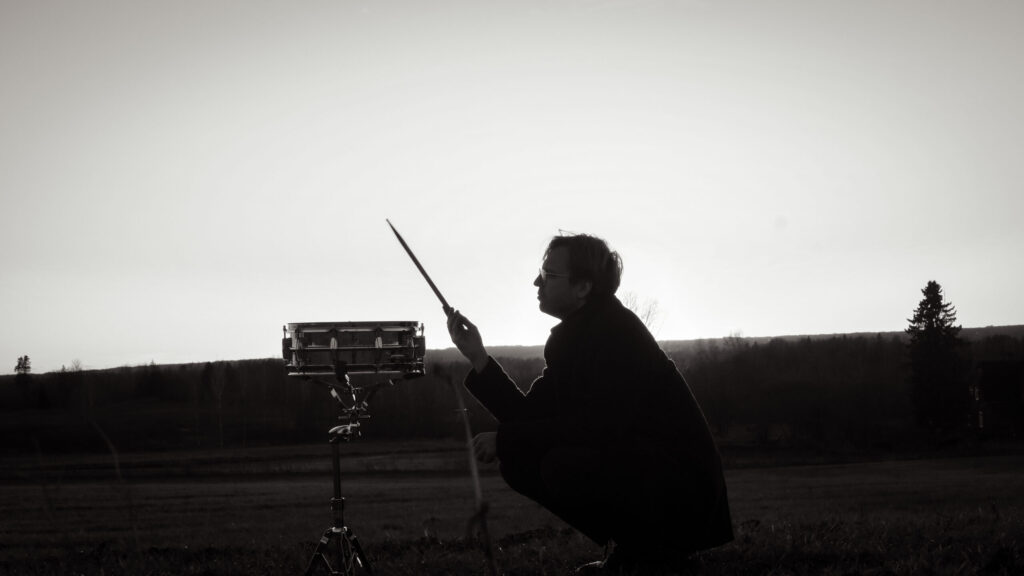

With Wild As the Wind, Ryan Farish opens another chapter in a career built around atmosphere, emotion and an unusually instinctive relationship with electronic music. Rather than presenting the album as a tightly controlled exercise in production, Farish lets the material breathe, following ideas that appear to move according to their own rhythm. The result is a release that sits comfortably between deep house, downtempo and dance, while retaining the spacious, cinematic character that has long distinguished his work.
The album’s concept is closely connected to its creative process. Farish describes the songs as ideas that could not be forced into existence, arriving instead like changing currents. That philosophy can be felt in the music itself. There is a sense of movement without urgency, with arrangements that seem to develop naturally instead of rushing towards obvious peaks. It gives Wild As the Wind a fluid identity, one where tracks can feel intimate and expansive at the same time.
Rhythm plays an important role in maintaining that balance. The grooves are controlled and elegant, often leaning into the hypnotic qualities associated with deep house while avoiding an overly club-focused approach. Percussive details sit within the arrangements rather than dominating them, allowing the pulse to support the melodic and atmospheric elements. Even when the beat becomes more pronounced, Farish keeps a sense of space around it, making the rhythm feel less like a command and more like a current carrying the music forward.
The synth work adds another layer to this movement. Farish has always shown an ability to use electronic textures for emotional purposes, and here the synthesizers frequently function as part of the album’s atmosphere rather than simply as melodic devices. Warm tones, softly evolving layers and wider electronic passages create depth without overcrowding the arrangements. Some sounds seem deliberately elusive, appearing briefly before dissolving back into the surrounding production. That quality gives the record a tactile feeling, almost as though its details are constantly shifting.
Atmosphere is ultimately where Wild As the Wind makes its strongest impression. The album does not depend on dramatic gestures to communicate emotion. Instead, it builds its character through subtle changes in texture, rhythm and melodic phrasing. There is something reflective in these compositions, but also a quiet sense of optimism. Farish’s music can work as background listening, yet it rewards closer attention, particularly when the production details begin to reveal themselves after repeated plays.
That ability to remain accessible without becoming predictable is one of the album’s most convincing qualities. Wild As the Wind feels polished, but not sterile. Its production carries the precision expected from an artist with decades of studio experience, while the arrangements retain a certain looseness that suits the album’s central idea of surrendering to inspiration. The contrast is important: everything sounds carefully considered, even when the music gives the impression of simply unfolding.
Farish’s long trajectory in electronic music also provides useful context. From early digital releases and international recognition to collaborations, chart positions, major label appearances and more than a billion streams across platforms, his catalogue reflects an artist who has consistently developed his own musical language. Yet Wild As the Wind does not sound like a retrospective statement. It feels more interested in continuing that exploration, finding new shapes within familiar emotional territory.
For a release of this kind, the absence of unnecessary excess becomes a strength. Farish understands that atmosphere needs room, and Wild As the Wind rarely sacrifices that space for effect. Deep house influences, downtempo sensibilities and dance-oriented structures coexist naturally, producing music that can move between focused listening and more immersive environments without losing its identity.
Wild As the Wind is, above all, a confident and finely produced album that embraces uncertainty rather than resisting it. Ryan Farish turns that idea into something audible: rhythms drift, synths shimmer and atmospheres expand without always revealing exactly where they are heading. It is a high-quality release, emotionally engaging and technically accomplished, and one we are genuinely pleased to host on our webzine with this review.