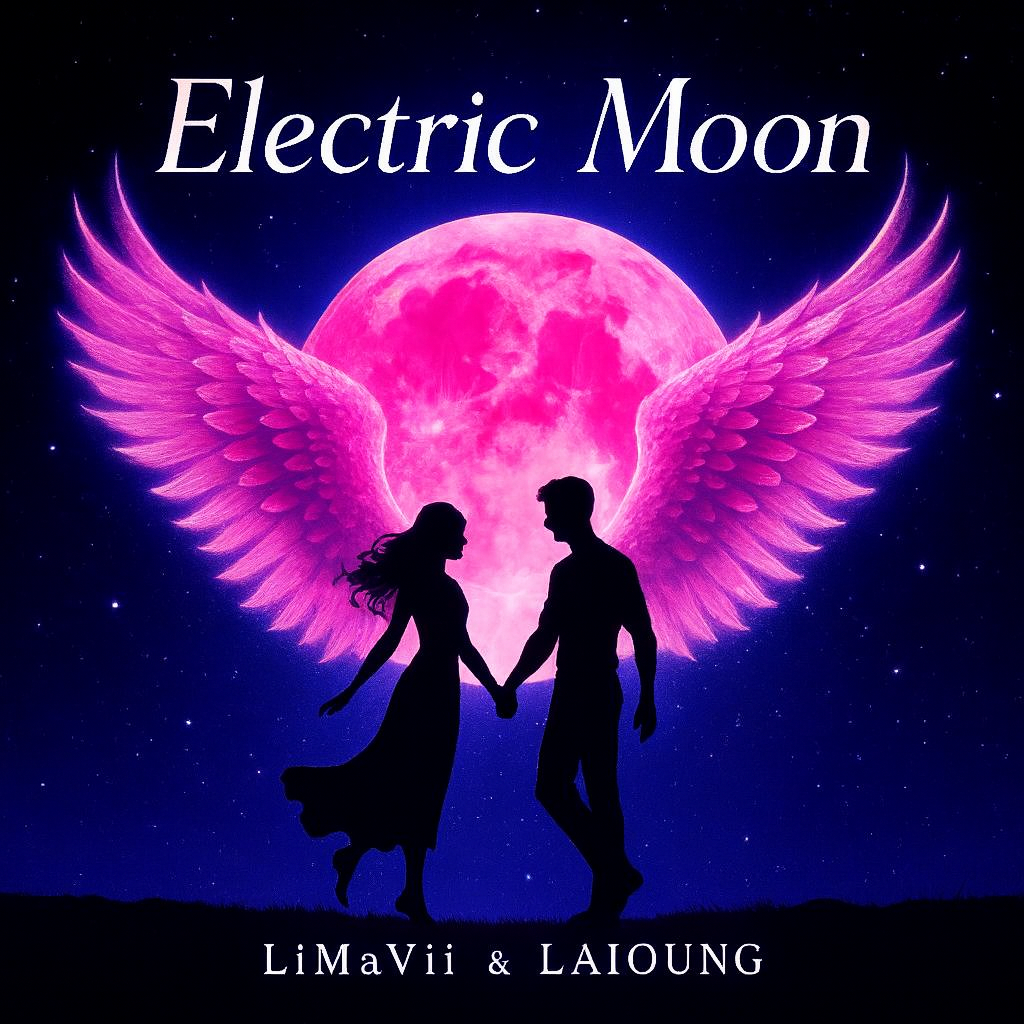

There is a particular kind of glow that surrounds Electric Moon, the new single by LiMaVii, and it doesn’t announce itself loudly. It hums. It lingers. Released on February 8, 2026, the track finds the Gdynia-born artist refining her approach to electronic pop by stripping away excess and leaning into atmosphere, tone, and emotional continuity. The result is a piece that feels less constructed than channeled.
From the opening bars, rhythm establishes a steady, almost tidal movement. The percussion is restrained yet purposeful — a soft electronic pulse that suggests motion without urgency. It doesn’t push the listener forward so much as draw them inward. The beat breathes. There’s space between the kicks, subtle syncopation in the hi-hats, and a low-end presence that anchors the track without overpowering it. Rather than building toward explosive drops, LiMaVii allows the groove to evolve organically, maintaining a fluid momentum that mirrors the song’s lyrical imagery of tides and lunar currents.
The synth work is equally deliberate. Pads shimmer in the background like distant starlight, textured but never cluttered. They swell and recede with a cinematic sensitivity, creating a wide sonic field that feels both intimate and expansive. A faint arpeggiated layer flickers through the mix at key moments, adding a sense of electricity beneath the surface calm. It’s electronic pop, certainly, but not the maximalist kind; this is electronic production guided by emotional narrative rather than by trend.
What truly shapes the identity of Electric Moon is its guitar presence, an element that subtly nods to the atmosphere of Purple Rain by Prince. The influence is not imitation. Instead, the guitar functions as an emotional undercurrent — slightly overdriven, expressive, almost vocal in its phrasing. It pulses in conversation with the lead vocal, responding rather than competing. At times it feels as though it inhales and exhales alongside the melody, carrying a quiet sensuality and a trace of melancholy. That balance between softness and voltage gives the track its distinctive tension.
Vocally, LiMaVii maintains a controlled intimacy. Her delivery avoids theatrical excess; it’s measured, close, and deliberate. There’s a warmth in her tone that suggests vulnerability, yet she never slips into fragility. The phrasing is fluid, often gliding over the beat rather than sitting squarely on it. In lines like “We met in the pulse of the full moon” and “Galaxies are born where our hearts collide,” the vocal performance sustains a sense of suspended time. She doesn’t rush the imagery. She lets it settle.
The atmosphere of the song is where its coherence becomes most apparent. Inspired by the Pink Full Moon and shaped through an organic collaboration with her producer, Electric Moon feels unified in mood. There are no abrupt transitions, no decorative flourishes designed merely to impress. Instead, the arrangement unfolds like a single emotional arc — lunar, electric, quietly intense. The mix leaves room for silence to speak; reverbs trail off into open space, creating a sensation of depth that borders on cinematic.

LiMaVii’s artistic trajectory, from the warmth and seasonal intimacy of “The Sound of X-Mas” to the more cosmic introspection of this release, suggests an evolving focus on energy and resonance. She approaches songwriting not simply as structure but as atmosphere-building. In Electric Moon, that philosophy becomes clear. The track doesn’t hinge on complexity. Its strength lies in cohesion — every rhythmic choice, every synth layer, every guitar swell contributing to a single emotional frequency.
There’s a sensual undercurrent throughout, though it remains understated. The electric elements never overwhelm the lunar calm; instead, they coexist. It is precisely this interplay — between intimacy and intensity, between earthbound rhythm and cosmic imagery — that gives the song its staying power. One listens not for spectacle but for immersion.
As a standalone single, Electric Moon stands out for its clarity of vision. It avoids chasing the louder currents of contemporary electronic pop and instead offers something more contained, more deliberate. It invites the listener into stillness and asks for attention rather than distraction. That restraint becomes its defining feature.
In a landscape often saturated with overproduction, LiMaVii delivers a high-quality release rooted in emotional coherence and sonic sensitivity. Electric Moon doesn’t demand to be heard at full volume; it reveals itself gradually, like light shifting across water. It is a piece that resonates long after it fades — not because of spectacle, but because of atmosphere.