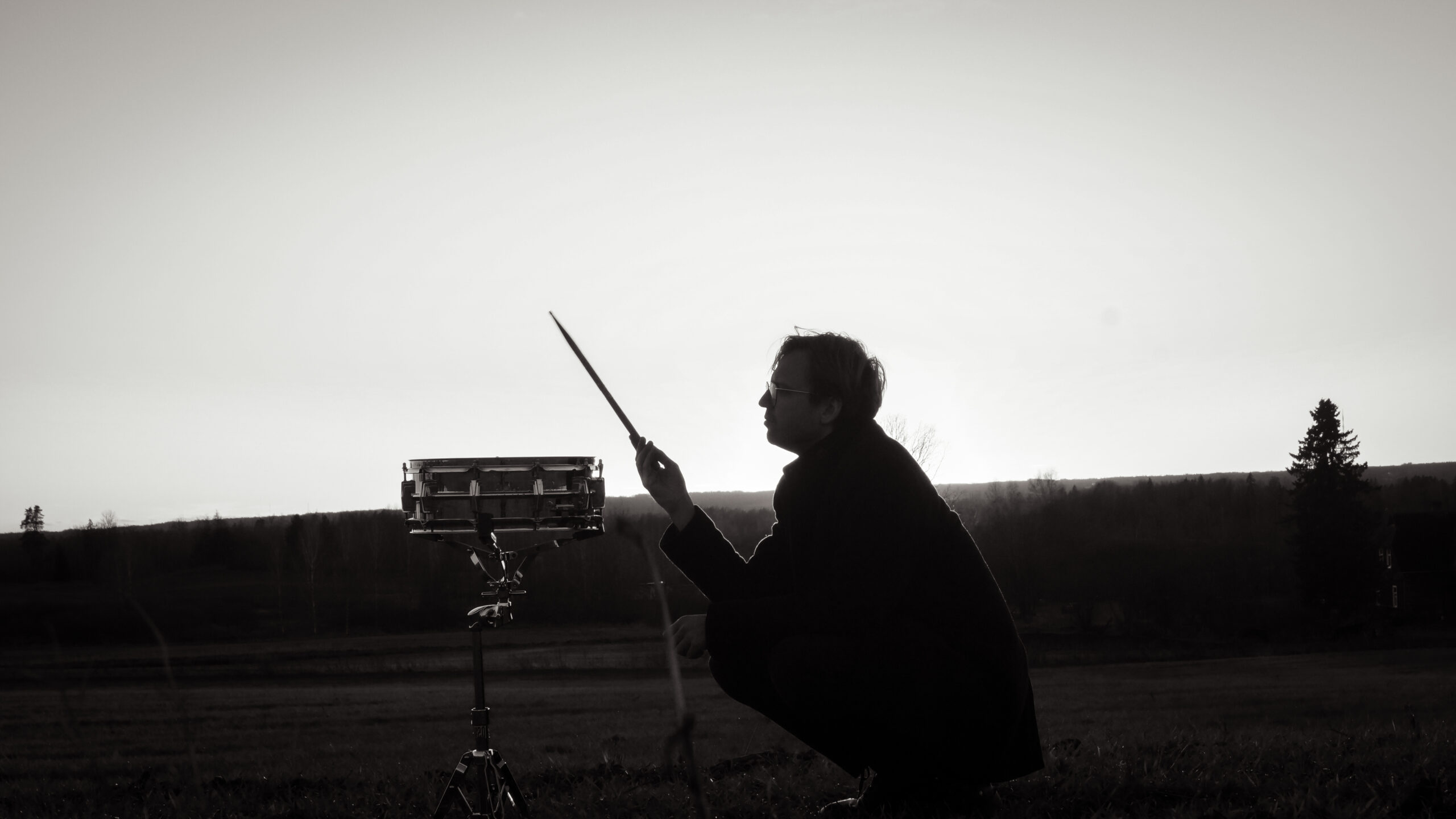

Rinalds Maksimovs introduces his debut album “Rincore” as a work built on tension: between the physical presence of drums and the elusive nature of electronic sound, between improvisation and careful studio construction. Developed across four years, from 2022 to 2026, the album feels less like a fixed statement than the result of an ongoing search for a personal musical language. Jazz, experimental electronics, ambient textures and minimalism all enter the picture, but none of them completely defines what happens here.
At the centre of “Rincore” is rhythm. Maksimovs approaches the drums not simply as a timekeeping instrument, but as a source of movement, texture and disruption. His playing can feel precise one moment and deliberately unstable the next, creating grooves that seem to shift beneath the surface. There is a physical quality to the rhythmic work, yet it never becomes overly demonstrative. Instead, the percussion often acts as a conversation with the electronic elements, leaving enough space for both sides to influence the direction of the music.
The electronic side of the album expands that conversation considerably. Synth sounds appear less interested in conventional melodic resolution than in building environments around the drums. Pulses, fragments and sustained tones create layers that can be warm, abstract or slightly disorientating, depending on their placement. Maksimovs clearly understands that electronic sound design can function as an instrument in its own right, and “Rincore” benefits from this approach. The production does not simply decorate the acoustic material; it changes the way the rhythmic ideas are perceived.
What makes the record particularly engaging is its sense of atmosphere. The quieter passages possess an almost suspended quality, while the more rhythmically active sections introduce a stronger dance-oriented impulse. This balance is one of the album’s most convincing characteristics. Even when the music moves towards avant-garde territory, there remains a pulse underneath it, sometimes obvious, sometimes almost hidden. That underlying movement gives the experimentation a sense of purpose rather than allowing it to become purely cerebral.
The track “Viegli nākamais liegums” is a good example of the album’s ability to inhabit that uncertain space between organic performance and electronic construction. The music seems to develop through small changes in texture and rhythmic emphasis, encouraging the listener to focus on details rather than waiting for conventional hooks. It is music that rewards attention, but it does not demand a rigid interpretation. There is room for instinct here.
Maksimovs’ background as a jazz drummer and composer, with studies in Latvia, Denmark and Sweden, is relevant without becoming the defining story of the album. His experience in improvisation is audible in the way sections breathe and interact, while his work with electronic production gives the record a distinctly contemporary edge. The collaboration with Gatis Zaķis during the album’s development also contributes to this meeting of live performance and studio experimentation.
“Rincore” ultimately succeeds because it does not treat the acoustic and electronic worlds as opposites. They coexist, collide and occasionally blur into one another. That approach gives the album a character that feels both exploratory and grounded, with enough rhythmic energy to remain engaging while preserving its more abstract instincts. It is a confident debut from an artist clearly willing to take risks without losing sight of musical communication.
For these reasons, “Rincore” stands out as a high-quality release and one we are genuinely pleased to host on our webzine. Rinalds Maksimovs has created an album with a strong identity, where jazz sensibility, experimental electronics and atmospheric sound design meet in a convincing balance. It is an ambitious first statement, and perhaps more importantly, it feels like the beginning of something rather than a conclusion.