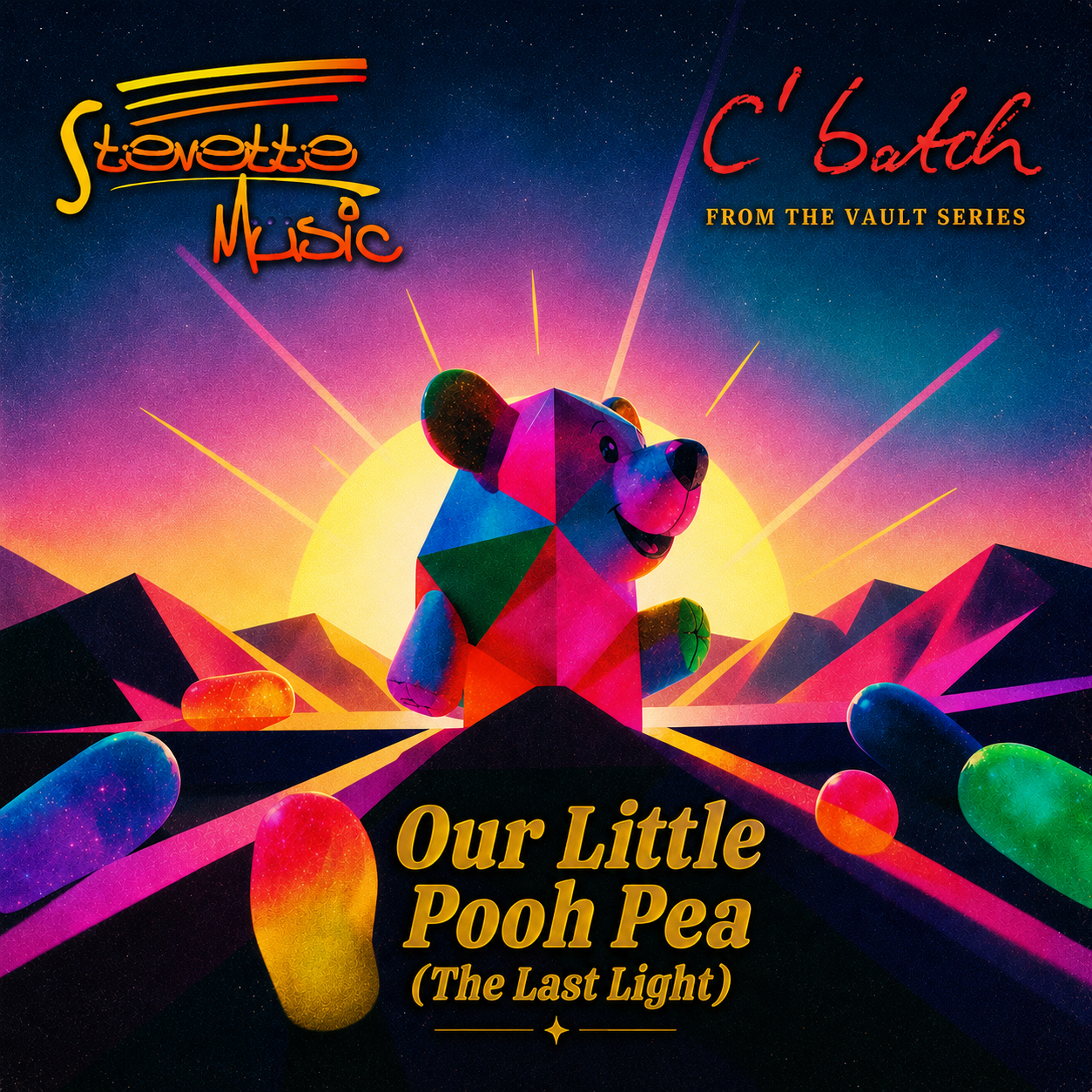

C’batch approaches “Our Little Pooh Pea (The Last Light) 4 – Cinematic” less like a conventional single and more like the discovery of a musical memory that had been waiting for a different context. The track carries an immediate sense of space, but its most striking element remains remarkably organic: the guitar. Originally performed as a solo over C’batch’s composition “Round & Round,” the guitar part has been taken out of its first environment and placed inside an entirely new electronic landscape. That simple shift in perspective gives the piece much of its character.
The guitar effectively becomes the voice of the composition. There are no lyrics to define a narrative, so phrasing, tone and timing have to do the expressive work. C’batch allows the instrument enough room to breathe, avoiding the feeling that every second needs to be filled. The result is an instrumental performance that feels personal without becoming overly demonstrative. Some passages suggest reflection, others something more unsettled, as if the music is moving through a scene whose meaning is deliberately left unresolved.
The rhythmic structure plays an important supporting role here. Rather than pushing the track towards a conventional electronic-rock climax, the rhythm seems designed to create movement beneath the cinematic surface. It gives the guitar a foundation without competing for attention, maintaining a measured pulse that contributes to the track’s sense of progression. There is a feeling of forward motion, but it is never hurried. This restraint works particularly well because the track depends on atmosphere as much as melody.
The synth work adds another dimension to that atmosphere. Electronic textures surround the guitar with a spacious, almost dreamlike character, expanding the recording beyond the limitations of a straightforward rock arrangement. The synths do not simply decorate the composition; they help reshape its emotional geography. Soft layers and atmospheric tones create depth around the central performance, giving the impression of a much larger environment. It is easy to imagine the music accompanying a film sequence, although it does not feel dependent on visual imagery to make its point.
“The Last Light” is an evocative title because the music itself seems to inhabit a transitional space. There is something in the combination of guitar and electronics that suggests the final moments of a journey, a memory gradually disappearing, or perhaps the first indication that darkness is beginning to recede. Importantly, C’batch does not force any of these interpretations. The ambiguity is part of the appeal. The listener is given an atmosphere rather than a prescribed story.
What makes the track particularly interesting is also the way it was created. A performance originally belonging to “Round & Round” has been reconsidered and given another life. That process says something about C’batch’s broader approach to music: an older recording does not necessarily have a fixed identity. With a new production environment, the same performance can reveal qualities that were previously less apparent. Here, the guitar solo becomes the starting point for an entirely different musical perspective.
There is a natural connection between this approach and C’batch’s wider Vault philosophy, in which material from different periods can be revisited through contemporary production. His background as a guitarist, composer, producer and synthesizer programmer is particularly evident in the balance between physical performance and electronic construction. The two sides coexist rather than compete.
“Our Little Pooh Pea (The Last Light) 4 – Cinematic” ultimately succeeds because it trusts atmosphere. It is electronic rock with a cinematic instinct, but also something more difficult to categorize: an instrumental built around the emotional possibilities of a rediscovered guitar performance. C’batch has turned an existing musical idea into a new destination, and the journey feels convincing. It is a high-quality release, thoughtfully produced and emotionally open, and one we are pleased to host on our webzine.