
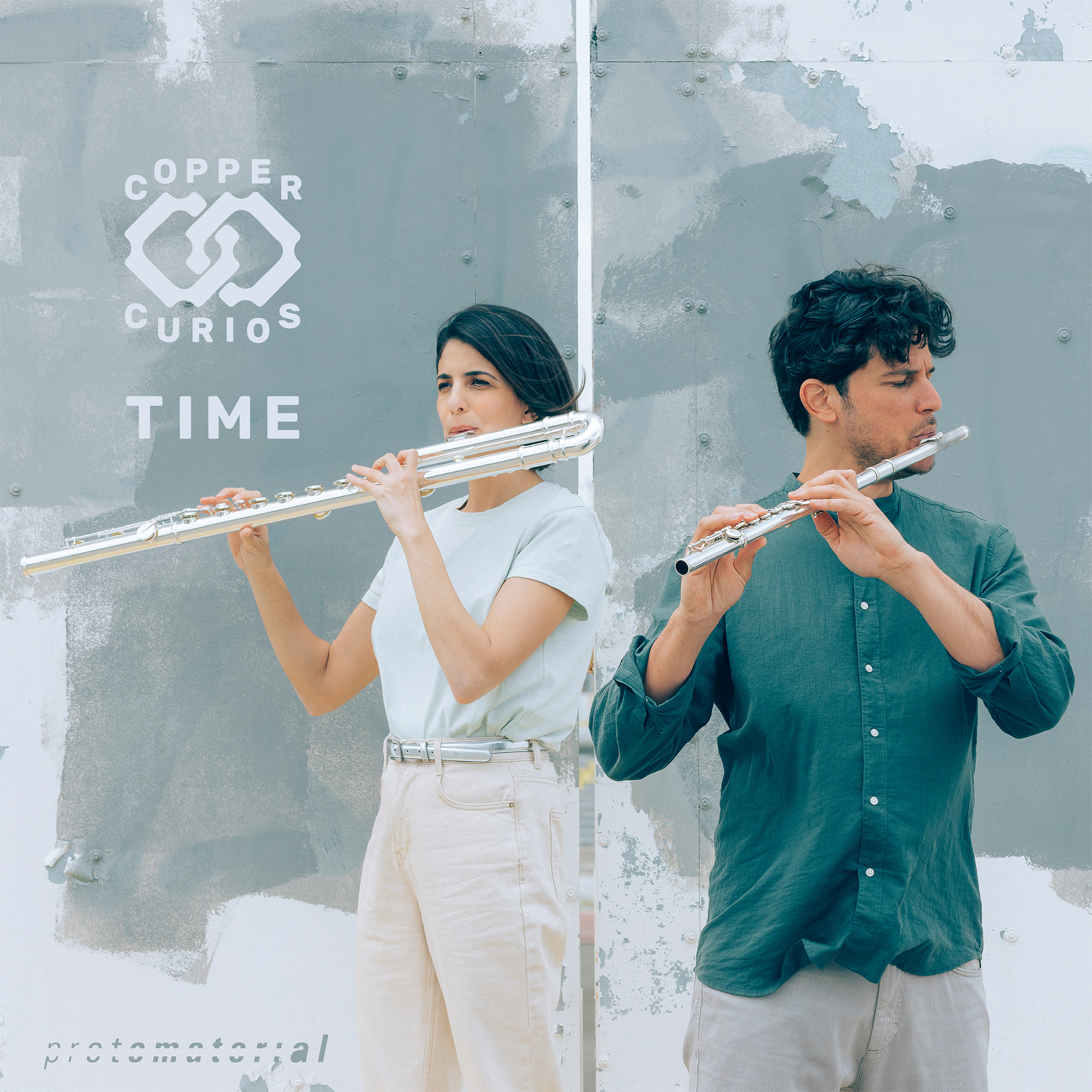

Copper Curios approach their debut album Time with a quiet kind of ambition, one that doesn’t announce itself loudly but gradually reveals its scope. Formed by Demetris Yiasemides and Eva Stavrou, the duo builds a language that feels rooted in classical discipline while constantly drifting into something more fluid, less easily defined. The result is an ambient-electronic work that resists fixed structure, leaning instead into a perception of sound as something unfolding, stretching, folding back on itself.
From the opening moments of Turning World, rhythm is treated less as a grid and more as a breathing organism. There are pulses, certainly, but they rarely behave in predictable loops. Instead, micro-patterns emerge and dissolve, sometimes carried by soft electronic undercurrents, sometimes implied through the phrasing of the flutes. It creates a sensation of movement without insisting on direction. You don’t follow a beat so much as inhabit it.
This approach continues throughout the album. In Still Point, rhythm becomes even more elusive, almost suspended. Sustained tones hover in place, while subtle electronic textures flicker at the edges, suggesting motion without ever fully committing to it. It’s a careful balancing act—too little movement and the piece would stagnate, too much and it would lose its tension. Copper Curios find a middle ground that feels instinctive rather than calculated.
The synth work plays a crucial role in shaping this environment. Rather than dominating the acoustic instruments, the electronics act as extensions of them. There are moments where it becomes difficult to distinguish where a flute ends and a processed signal begins. In Flow, this interplay is particularly evident. Layers of airy flute lines weave through soft electronic harmonies, occasionally locking into brief, hypnotic patterns before slipping away again. The synth textures here are warm, almost tactile, avoiding the cold precision often associated with electronic music.
At times, the album leans into more defined rhythmic territory. Echoes introduces a slightly more pronounced pulse, though even here it feels softened, filtered through layers of reverb and delay. The beat doesn’t dictate the piece; it coexists with it. There’s a sense that rhythm is being observed from a distance, rather than imposed from within.
Atmosphere is where Time finds its strongest voice. The album is deeply immersive, but not in an overwhelming way. It invites attention without demanding it. There’s space—real space—between sounds, allowing each element to resonate fully. This is particularly noticeable in Fate, where sparse melodic fragments drift across a wide sonic field, creating a feeling of openness that borders on stillness.
Memories, one of the closing pieces, brings many of these elements together. The rhythmic structure remains understated, almost implied, while the synth layers expand into something more enveloping. The flutes, meanwhile, carry a sense of fragility, as if the melodies could dissipate at any moment. It’s a fitting conclusion, not because it resolves the album’s ideas, but because it leaves them suspended.
What stands out across Time is the consistency of its vision. The duo’s background in classical music is evident, not just in their technical control but in their attention to detail. Every sound feels placed with care, even when the overall structure appears loose. At the same time, there’s a willingness to let things remain unresolved, to embrace ambiguity rather than avoid it.
This tension—between structure and freedom, between acoustic and electronic, between movement and stillness—gives the album its character. It doesn’t aim for immediate impact. Instead, it unfolds gradually, revealing new layers with each listen. There’s a sense of patience in the way the music develops, as if it exists outside of conventional time.
Time is, ultimately, a work that rewards close listening. Its rhythmic subtlety, its nuanced synth work, and its carefully constructed atmosphere come together to form a release of notable depth. A debut that feels fully formed, yet open-ended.


