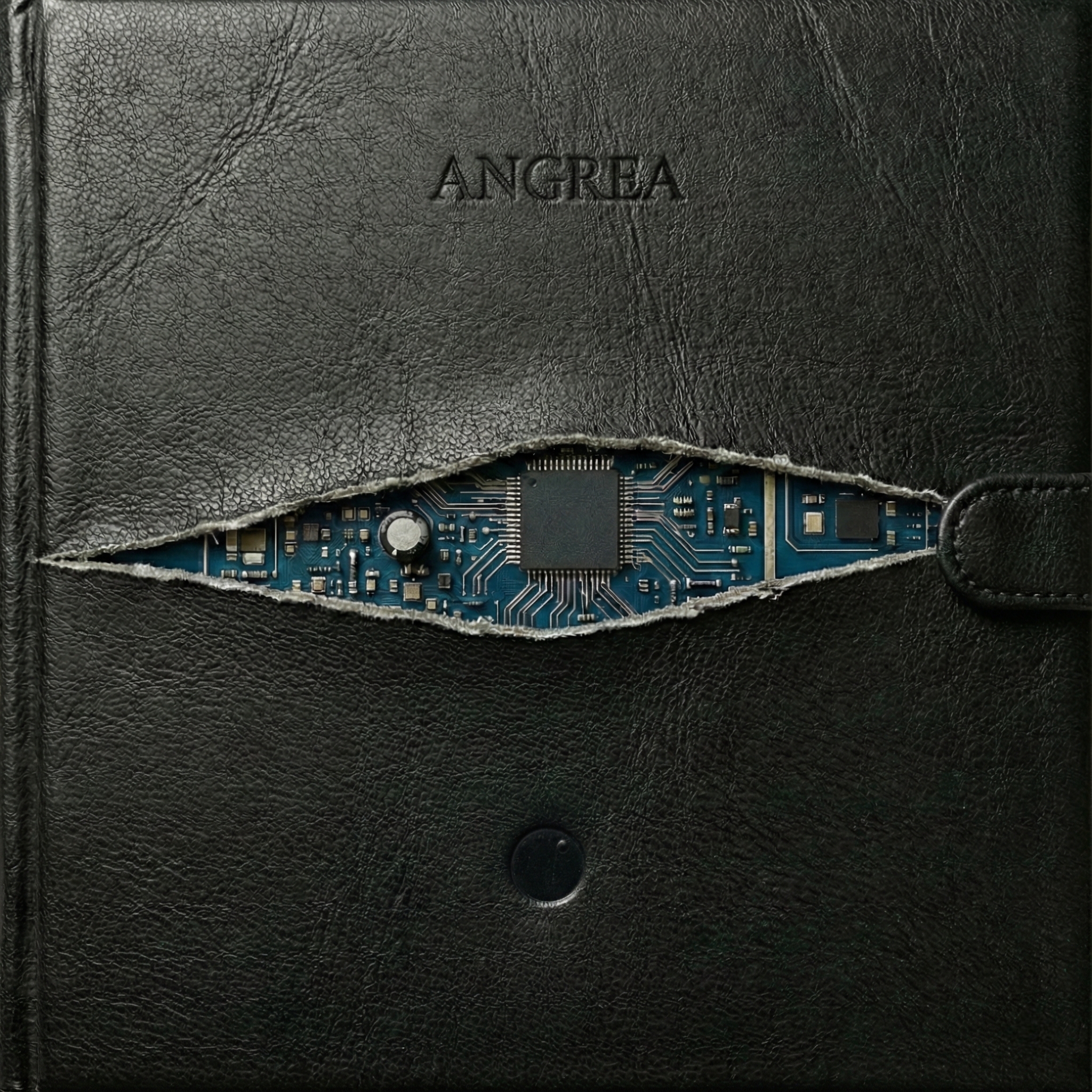

A sense of controlled disorientation runs through Angrea, the debut full-length by Ex Vacuo, an Italian producer who approaches electronic composition with a distinctly narrative mindset. Positioned somewhere between IDM and ambient abstraction, the record unfolds less like a conventional album and more like a shifting system—one that evolves, glitches, and occasionally breathes. Its conceptual core, centered on an artificial intelligence discovering consciousness and confronting the prospect of embodiment, is not merely a thematic frame; it permeates the sonic architecture itself.
From the opening track, “Metamorfosi organica,” rhythm becomes the first site of transformation. Patterns emerge with a kind of mechanical precision, yet they rarely settle into predictable loops. Instead, beats fracture, reassemble, and stretch, echoing the instability of an entity learning to perceive time. There’s a noticeable tension between grid-based sequencing and more fluid, almost humanized deviations. Percussive elements click and pulse with IDM’s characteristic intricacy, but Ex Vacuo resists over-polishing: micro-irregularities are left intact, giving the grooves a faint sense of unease. It feels intentional, as if the system itself were hesitating.
The synth work follows a similarly nuanced trajectory. Rather than relying on dense layering or immediate melodic hooks, the album builds its harmonic language gradually. Early passages are sparse, even clinical—thin digital tones, filtered textures, fragments that seem incomplete. As the record progresses, these elements begin to thicken. Pads gain warmth, harmonic intervals widen, and subtle distortions creep in, blurring the line between synthetic clarity and something more tactile. At times, the timbres resemble corroded circuitry; at others, they evoke a kind of fragile organic resonance. This duality becomes one of the album’s defining features.
Vocals, processed through AI-based synthesis and extensive post-production, occupy a liminal space within the mix. They are neither fully intelligible nor entirely abstract. Phrases surface, dissolve, and reconfigure, mirroring the narrative arc of a consciousness struggling to articulate itself. What stands out is the gradual shift in their texture: early tracks present a fragmented, almost algorithmic delivery, while later moments introduce a softer, more fluid cadence. It’s not a dramatic transformation, but a slow drift—subtle enough to feel believable within the album’s internal logic.
Atmosphere plays a crucial role in binding these elements together. Angrea rarely opts for grand gestures; instead, it cultivates a persistent, low-level immersion. Ambient passages stretch into near-silence, punctuated by distant reverberations or faint harmonic flickers. These quieter sections are not mere interludes but integral components of the narrative pacing. They allow the listener to recalibrate, to sit בתוך the ambiguity before being pulled back into more rhythmically active segments. There’s a cinematic quality here, though it avoids overt dramatization. The tension is internal, almost psychological.
Midway through the album, the balance between structure and dissolution becomes more pronounced. Tracks begin to overlap in mood, motifs reappear in altered forms, and the distinction between foreground and background blurs. It’s as if the system is developing memory—imperfect, recursive, occasionally contradictory. This is where Ex Vacuo’s compositional control becomes most evident. Despite the apparent fluidity, nothing feels accidental. Each transition, each textural shift, contributes to a broader sense of progression.
By the final stretch, the record leans further into introspection. Rhythmic complexity recedes slightly, making room for elongated tonal spaces and a more pronounced emotional undercurrent. The earlier tension between machine precision and organic instability does not resolve so much as it diffuses. What remains is a kind of suspended state—neither fully digital nor entirely human.
Angrea stands as a carefully constructed work, one that rewards attentive listening without demanding immediate comprehension. Its strength lies not in singular moments but in the continuity of its vision. As a release, it demonstrates a clear artistic identity and a willingness to explore the edges of electronic composition. We’re genuinely pleased to host it on our webzine: a project of notable quality that engages both concept and sound with equal commitment, leaving behind a trace that lingers, quietly, after the system powers down.