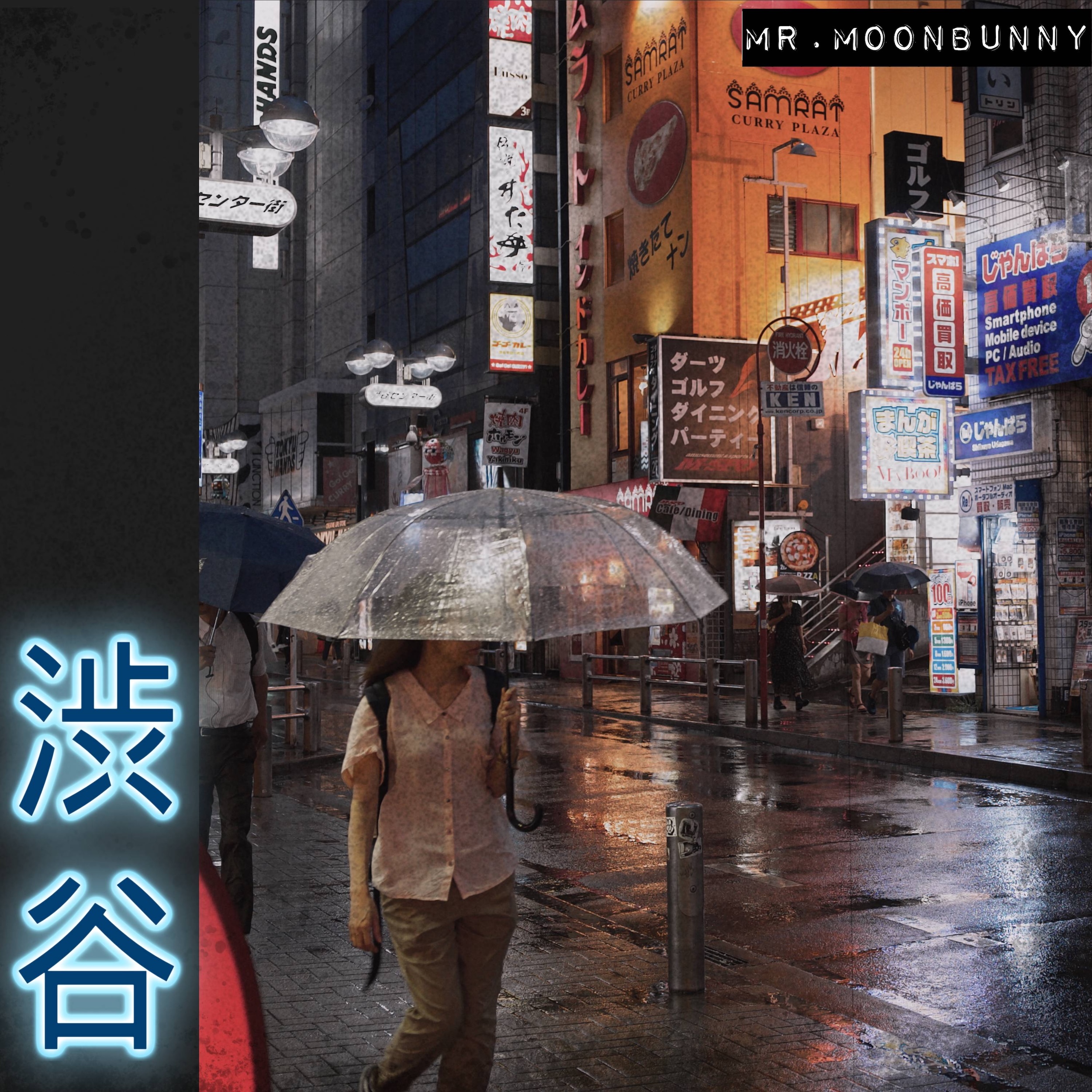

A hazy glow seems to rise from the speakers as “I Neon di Shibuya” unfolds, a track that doesn’t rush to announce itself but rather settles into the room with quiet confidence. Under the alias Mr.MoonBunny, Samuele Pozzi approaches groove-based music with a patience that feels increasingly rare, choosing depth over immediacy and texture over spectacle. The result is a piece that invites attention without demanding it, slowly revealing its character through detail and restraint.
From a rhythmic standpoint, the track leans into an intentionally “imperfect” groove, one that subtly resists quantization in favor of a more human pulse. The drum programming carries echoes of classic boom-bap traditions, yet it avoids nostalgia traps by introducing slight temporal displacements—micro-delays in the snare, a kick that occasionally drags just behind expectation. This elasticity gives the rhythm a breathing quality, reminiscent of the loose swing associated with producers like J Dilla, though never imitative. Instead, it feels internalized, almost instinctive, as if the groove is being felt rather than constructed.
The percussive elements are crisp but never sterile. Hi-hats flicker in and out of focus, sometimes tight and controlled, other times opening into airy textures that blur the rhythmic grid. There’s a sense that each hit has been placed with deliberation, yet allowed enough freedom to retain its organic edge. It’s a delicate balance, and one that speaks to Pozzi’s background as both musician and sound engineer—technical precision serving expressive looseness, not the other way around.
Synth work plays a central role in shaping the track’s atmosphere. Rather than dominating the mix, the synthesizers drift through it like neon reflections on wet asphalt—soft, diffused, and constantly shifting. Pads carry a retro-futuristic timbre, somewhere between analog warmth and digital clarity, evoking a cityscape that exists both in memory and imagination. Melodic fragments appear briefly, almost like passing lights seen from a moving train, before dissolving back into the harmonic fabric.
There’s a notable restraint in how these elements are layered. Nothing feels overcrowded; space is treated as an active component of the composition. This allows the listener to focus on subtle interactions—the way a synth swell gently overlaps with a bass phrase, or how a rhythmic accent triggers a slight tonal shift in the background. It’s music that rewards close listening, revealing new nuances with each pass.
The bass, unsurprisingly, anchors the entire piece. Given Pozzi’s recent focus on the instrument, it becomes more than just a foundation—it acts as a narrative voice. Warm, rounded, and deeply embedded in the groove, the bassline moves with a quiet authority, guiding the track without ever overpowering it. There’s a tactile quality to its presence, as if each note has been shaped by hand rather than programmed. It reinforces the track’s emphasis on feel, on the physicality of sound.
Atmospherically, “I Neon di Shibuya” captures something elusive. It’s not simply a depiction of urban nightlife, but a more introspective rendering of it—a solitary walk through illuminated streets, where external stimuli blur into internal reflection. The influence of Japanese aesthetics, filtered through a hip hop sensibility, is evident but understated. Rather than leaning on obvious cultural markers, the track conveys its setting through mood and pacing, allowing listeners to project their own imagery onto the soundscape.
There’s also a philosophical undercurrent at play. In resisting the fast-consumption model of contemporary music, Mr.MoonBunny offers an alternative listening experience—one that values slowness, repetition, and immersion. The track doesn’t build toward a conventional climax; instead, it unfolds in cycles, each variation adding depth rather than intensity. This approach may challenge listeners accustomed to more immediate gratification, but it ultimately provides a more lasting engagement.
Vocally, if present, elements are treated as textures rather than focal points, blending into the overall mix in a way that reinforces the track’s cohesive identity. Nothing feels isolated; everything exists in relation to everything else, contributing to a unified sonic environment.
It’s worth noting how confidently this release holds its aesthetic line. There’s no sense of compromise or trend-chasing—only a clear artistic vision carried through with consistency and care. That clarity is perhaps what makes the track stand out most. In a landscape often driven by algorithms and immediacy, “I Neon di Shibuya” feels deliberately out of step, and better for it.
As a webzine, we’re genuinely pleased to host and highlight a release of this caliber. Not because it demands attention, but because it earns it—gradually, quietly, and with a kind of understated conviction that lingers long after the final note fades.