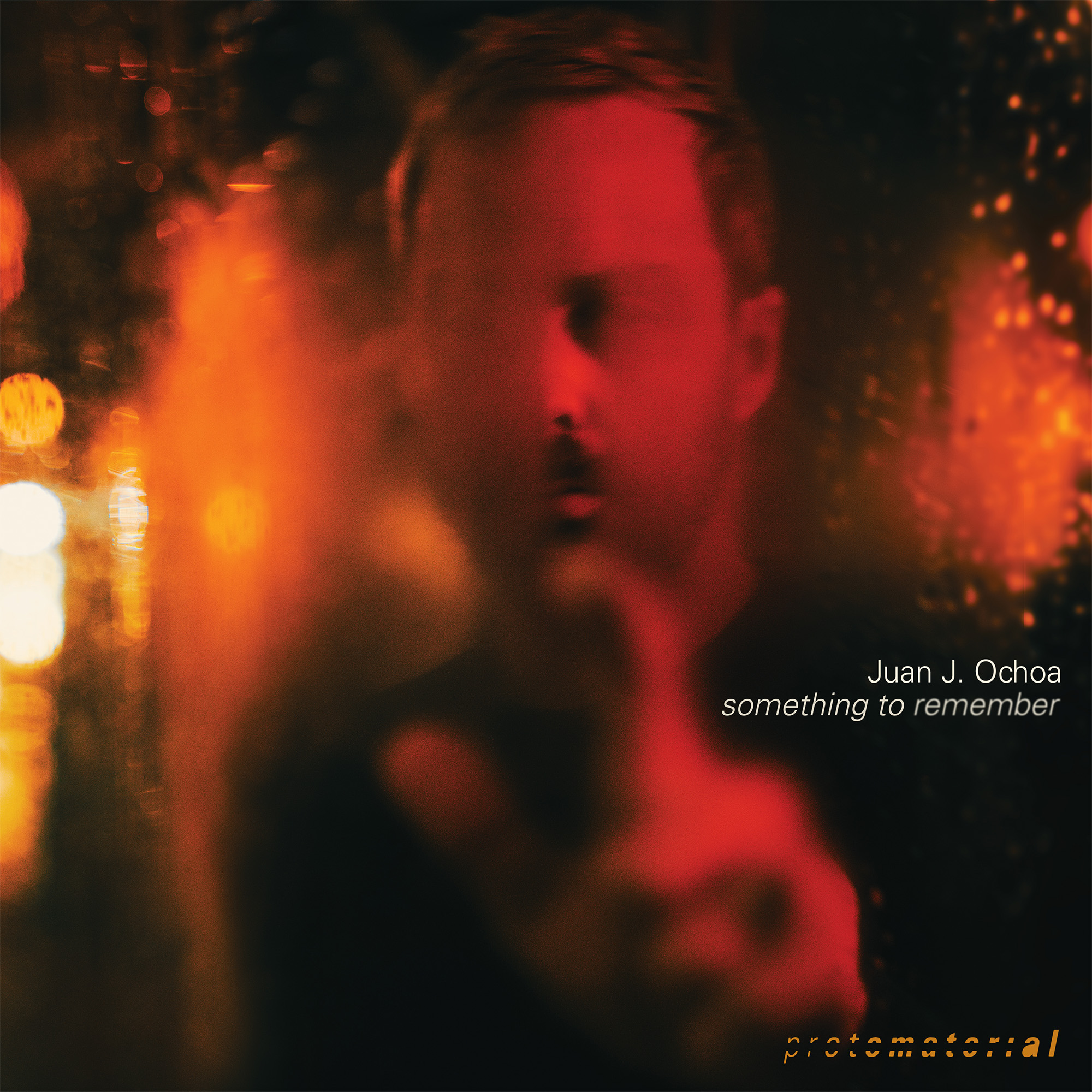

A subtle tension runs through Something to Remember, the fourth full-length release by Juan J. Ochoa. The album does not seek perfection, nor does it attempt to disguise its fractures behind polished production. Instead, it leans into instability with unusual confidence, turning fragile textures and incomplete gestures into part of its emotional language. Across eight compositions suspended between ambient, new age and chillout territories, Ochoa constructs a listening experience that feels intimate without becoming sentimental.
The record opens with “Alone,” perhaps the clearest statement of intent on the album. Built around an out-of-tune upright piano recorded during isolation, the piece immediately establishes the human dimension that defines the entire project. The piano notes arrive unevenly, some resonating longer than expected, others dissolving into room noise and mechanical creaks. Yet the rhythmic structure remains remarkably controlled. Ochoa avoids rigid tempo patterns, preferring a drifting pulse that behaves almost like breathing. The absence of quantized precision gives the track its emotional gravity, allowing silence and resonance to shape the composition as much as melody itself.
That relationship between rhythm and atmosphere becomes even more evident on “Night Bus.” Here, ambient electronics wrap around soft piano figures while distant synthetic textures emerge like reflections on wet pavement. The rhythmic movement is minimal but persistent, guided by low-frequency synth swells and lightly processed repetitions that imitate the hypnotic sensation of nocturnal travel. Rather than pushing forward, the track circles around itself, generating a dreamlike continuity that recalls both contemporary ambient composition and cinematic sound design. Small imperfections in timing remain audible throughout, reinforcing the album’s broader refusal of sterile digital clarity.
“Hannah” introduces one of the album’s most compelling sonic experiments. Using screws inserted into the piano strings, Ochoa destabilizes the instrument’s harmonic center, creating metallic overtones and ambiguous tonalities that never fully resolve. The prepared piano technique, clearly indebted to the legacy of John Cage, is handled with restraint rather than abstraction. Instead of transforming the piano into pure noise, Ochoa allows recognizable melodic fragments to coexist with altered resonances. The result is unsettling but deeply expressive. Rhythmic patterns appear fragmented, almost hesitant, while subtle electronic drones underneath maintain a suspended emotional tension.
One of the album’s quiet surprises arrives with “Extrait de Bayadère,” a reinterpretation of material originally associated with Ludwig Minkus. Ochoa slows the melodic phrasing dramatically, turning ballet motifs into something inward-looking and meditative. The piece unfolds with sparse pacing, leaving enough empty space for each note to linger in the air. Here the synth work remains discreet, functioning more as atmospheric coloration than structural foundation. Warm pads and distant harmonic layers gently expand the acoustic dimensions of the piano without overpowering its fragile character.
“Paradise Found” gradually widens the album’s emotional scale. What begins as a restrained piano meditation slowly accumulates orchestral textures and ambient harmonies until it reaches a luminous climax. Even in its more expansive moments, however, the production never becomes excessive. Ochoa demonstrates notable discipline in his arrangement choices, allowing every synthetic layer to enter organically. The rhythmic development remains understated throughout, driven less by percussion than by evolving harmonic motion and textural density. That decision gives the track a floating sensation, as if the music were continuously unfolding without ever fully landing.
The final trilogy — “Earth I,” “Earth II,” and “Earth III” — functions almost like a gradual dissolution. Ambient electronics dominate the first section, where elongated synth drones and soft environmental textures create an immersive spatial atmosphere. The second movement returns to prepared piano, introducing bowed-string sounds and irregular resonances that blur the line between acoustic and electronic timbre. By the closing part, Ochoa merges both worlds into a slow-moving synthesis of minimal rhythm, suspended harmony and meditative ambience.
What makes Something to Remember particularly effective is its refusal to dramatize its imperfections. The album never announces its humanity through exaggerated vulnerability; instead, it simply allows imperfections to remain visible. That approach gives the music a rare sincerity. The synth arrangements feel warm rather than decorative, the rhythmic structures breathe naturally, and the atmospheric design consistently favors emotional presence over technical spectacle.
In a musical landscape increasingly dominated by algorithmic precision and polished surfaces, Juan J. Ochoa delivers a release that feels deeply tactile and personal. Something to Remember stands as a high-quality work of ambient and neoclassical exploration, one that transforms fragility into its strongest artistic statement.