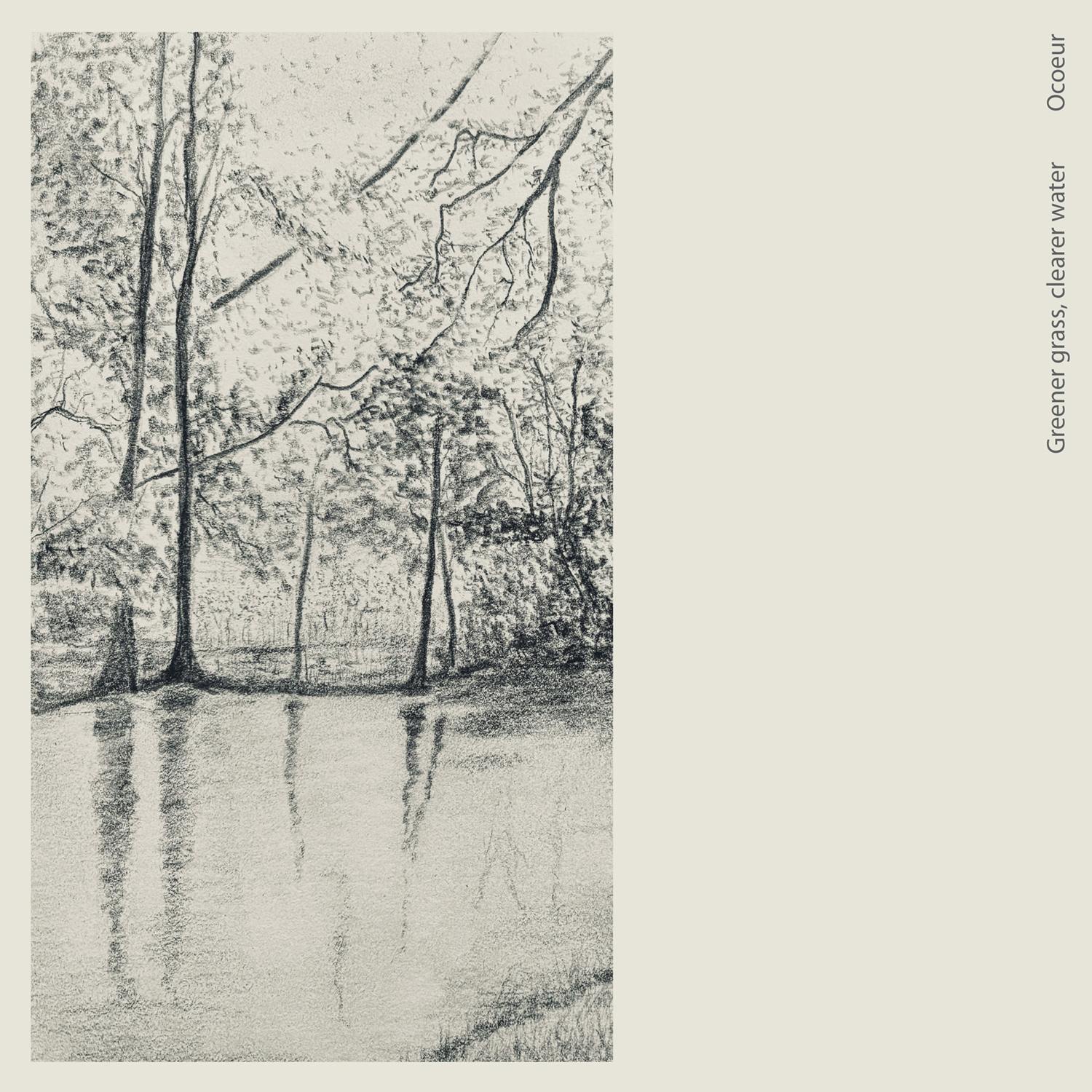

A quiet sense of suspension defines Greener Grass, Clearer Water, the latest full-length from Ocoeur, a project that has steadily refined its language across more than a decade of releases. Behind the alias stands Franck Zaragoza, a French composer whose trajectory has consistently gravitated toward introspection, minimalism, and a cinematic sensitivity to space. This eleventh album feels less like a progression in the conventional sense and more like a distillation—an intentional stripping away of rhythmic scaffolding in favor of something more elusive, more fragile.
The absence of beats is the first element that shapes the listening experience. Where earlier works occasionally leaned on subtle rhythmic undercurrents or glitch-inflected textures, here rhythm dissolves into suggestion. It survives in the pacing of harmonic shifts, in the slow swell and decay of synth layers, in the almost tidal movement of sound. Timing becomes elastic, guided less by structure and more by breath-like expansions. This approach gives the compositions a hovering quality, as if each piece is suspended just above resolution, never quite settling.
Synth work plays a central role, though it avoids any overt display of virtuosity. Zaragoza favors tonal clarity over complexity, building his pieces from sustained chords, faint melodic fragments, and carefully sculpted drones. There is a tactile softness to the sound design—pads that feel porous, edges that blur rather than cut. Occasionally, a higher register line emerges, reminiscent of distant piano figures or processed strings, but even these elements resist becoming focal points. Instead, they fold back into the broader texture, reinforcing the album’s commitment to cohesion over contrast.
Atmosphere, unsurprisingly, becomes the dominant narrative device. The record unfolds as a sequence of vignettes, each one evoking a distinct yet interconnected environment. “Clouds Never Die” opens with a sense of openness that borders on weightlessness, its harmonic progression barely perceptible yet emotionally resonant. “Tomorrow, the Birds Will Sing” introduces a slightly warmer tonal palette, though it retains the same restrained dynamic range. These early moments establish a kind of sonic geography—expansive, unhurried, and quietly reflective.
As the album progresses, subtle variations begin to surface. “Lumières” carries a faint luminosity, achieved through delicate shifts in timbre rather than melodic development. “Le chemin du retour” introduces a deeper, almost meditative drone, suggesting a return inward rather than outward. The sequencing feels deliberate, guiding the listener through a continuum rather than a series of discrete tracks. Transitions are often imperceptible, reinforcing the impression of a single, extended composition segmented for convenience rather than necessity.
One of the more striking aspects of Greener Grass, Clearer Water is its handling of emotional weight. The record does not rely on dramatic crescendos or overt melancholia. Instead, it operates in a narrower emotional bandwidth, where nuance carries the burden of expression. There is a persistent sense of calm, but it is not entirely reassuring. Beneath the surface, a quiet tension lingers—an awareness of fragility that never fully resolves. This duality becomes particularly evident in tracks like “What Are You Running After?” and “Silences,” where the interplay between stillness and subtle dissonance creates a feeling of suspended unease.
The latter half of the album continues this exploration with a slightly more introspective tone. “Blue Sky and Golden Leaves” introduces a hint of warmth, though it remains understated, almost fleeting. “Let Go” leans further into minimalism, reducing its elements to near-emptiness without losing coherence. By the time “Your Smile” closes the record, the atmosphere has thinned to a delicate trace, leaving behind an impression rather than a conclusion.
In terms of sonic lineage, Zaragoza’s influences—ranging from classical composition to cinematic scoring—are present but never overtly referenced. The album situates itself at the intersection of ambient, neoclassical, and drone, yet it resists easy categorization. Its strength lies precisely in this ambiguity, in its refusal to anchor itself to a single tradition.
As a release, Greener Grass, Clearer Water stands as a carefully constructed work that prioritizes restraint over statement. It invites attentive listening without demanding it, offering layers that reveal themselves gradually. Within the context of contemporary ambient music, it occupies a space that feels both familiar and distinctly personal.
A work of notable quality, it finds a natural place within the pages of a webzine attentive to detail and atmosphere, not through grand gestures but through the quiet confidence of its execution.