
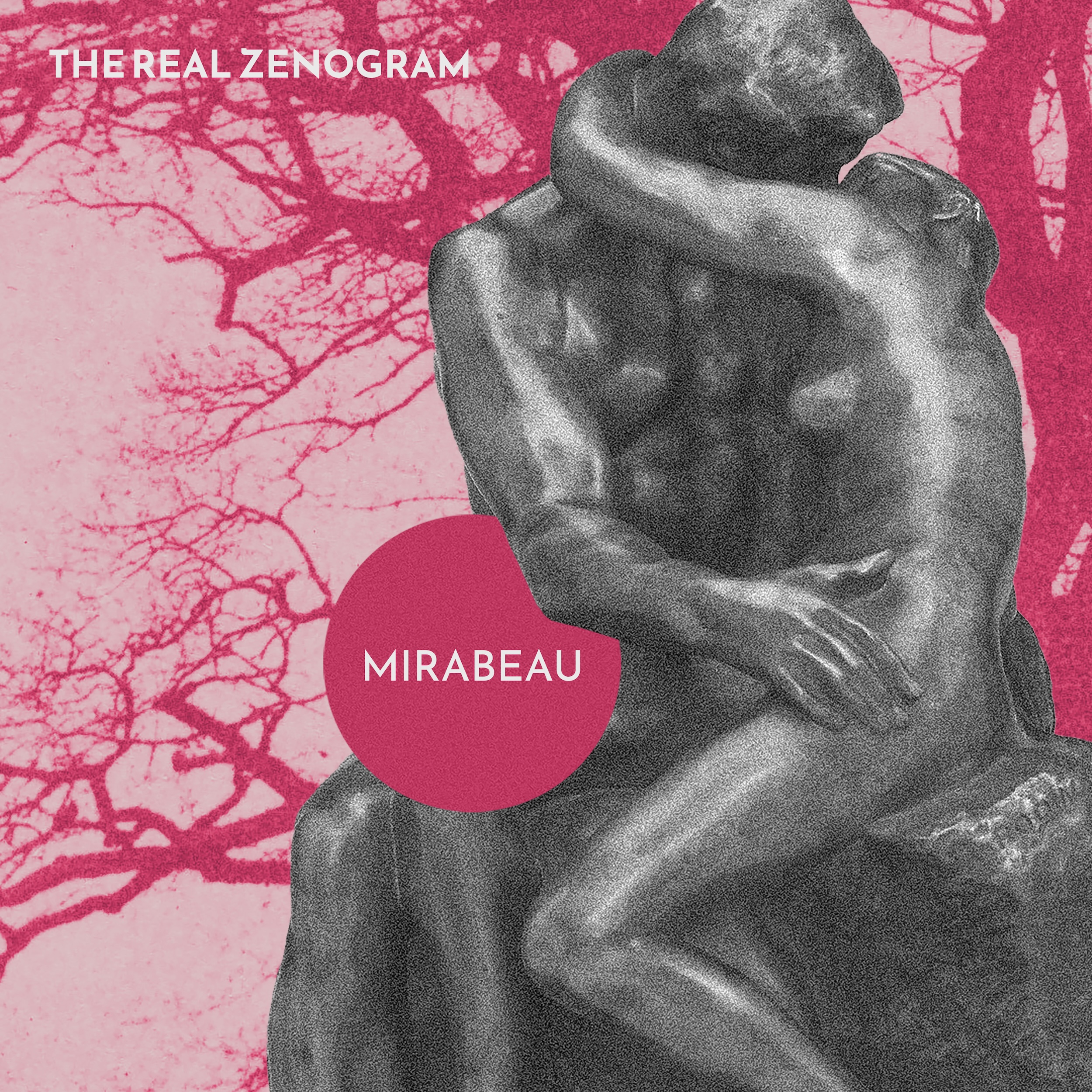
With Mirabeau, The Real Zenogram delivers a song that feels less like a debut and more like the resurfacing of something that has been quietly alive for decades. Rooted in experimental and new wave sensibilities, the track carries the weight of time without sounding dated, unfolding as a carefully paced meditation where literature, electronics, and memory intersect.
The rhythmic structure is deliberately restrained. Rather than driving the song forward in obvious ways, the beat seems to hover, guided by the dry, almost ritual pulse of the Behringer RD-9. Its patterns are steady but never mechanical, leaving small gaps where silence becomes part of the rhythm. This measured approach mirrors the emotional core of the song: movement without resolution, flow without arrival. The groove never insists; it accompanies, allowing the listener to settle into the song’s internal tempo.
Synthesizers play a central role, particularly the vintage Korg M1 textures that form the harmonic backbone. These sounds are not used for nostalgia alone. They arrive slightly blurred, softened at the edges, as if filtered through distance and recollection. Pads swell and recede in slow cycles, while subtle melodic fragments appear and dissolve before fully announcing themselves. The effect is hypnotic, but not in a purely electronic sense; it is cinematic, evoking scenes rather than hooks, moods rather than statements.
Layered within this electronic framework is the presence of guitar, a ’90s Fender Stratocaster that surfaces discreetly, often more as texture than as lead voice. When it does step forward, it carries a restrained melancholy, echoing late-’80s and early-’90s post-punk atmospheres without directly referencing them. The guitar lines feel human, slightly imperfect, providing contrast to the controlled precision of the synths. This dialogue between organic and electronic elements becomes one of the track’s defining characteristics.
At the heart of Mirabeau lies Guillaume Apollinaire’s 1913 poem Le Pont Mirabeau, and the song treats its source with care rather than reverence. The vocal delivery is understated, almost conversational, allowing the words to breathe. There is no attempt to dramatize the text excessively; instead, the lyrics are carried along by the arrangement, as if floating on the current suggested by the poem itself. The recurring idea that “the days go by and I remain” settles into the track like a quiet refrain, less a chorus than a thought that refuses to leave.
The atmosphere is consistently melancholic but never heavy-handed. There is darkness here, yet it feels reflective rather than oppressive. Influences from European cinema can be sensed in the pacing and the way scenes seem to shift subtly from section to section. The song does not rush to resolve its emotions. It lingers, allowing tension and calm to coexist, creating a sense of suspended time that suits the literary foundation of the piece.
Production choices reinforce this mood. Recorded in a home studio yet mastered at AIR Studios in London, Mirabeau balances intimacy with depth. The mix leaves space around each element, avoiding overcrowding, and the mastering adds clarity without stripping away the song’s softness. Nothing feels over-polished; the track retains a slightly grainy quality that works in its favor, aligning with its long gestation and reflective tone.
As a release, Mirabeau stands as a high-quality work that speaks to listeners interested in alternative music shaped by poetry, film, and vintage electronics. It does not chase immediacy or easy categorization. Instead, it invites attention and patience, rewarding close listening with nuance and atmosphere. We are pleased to host this release on our webzine, as it represents an approach to songwriting that values depth, continuity, and artistic coherence over trends—music that takes its time, and asks the same of its audience.