
Missing Ear, alias del batterista e sound designer sperimentale italiano Matteo Gualeni, torna con “Hotel Infinito”, un album che espande ulteriormente la sua ricerca tra suono e percezione dello spazio.
Missing Ear delinea nella sua musica un universo sonoro immersivo in cui la batteria diventa materia viva, ambiente e dispositivo percettivo. Ispirato al paradosso dell’“hotel infinito” di Hilbert, il disco riflette un’idea di composizione come struttura in continua espansione, capace di accogliere e riorganizzare costantemente nuovi elementi sonori, tra ritmiche decostruite, texture elettroniche e architetture spaziali.
Artista milanese attivo tra performance live, produzione e sound design, Missing Ear sviluppa una pratica che parte spesso dalla registrazione acustica della batteria per poi trasformarla, attraverso processi digitali e analogici, in paesaggi sonori stratificati e in continua mutazione. Il suo lavoro si colloca tra ricerca post-club, sperimentazione elettronica e sound art, con riferimenti che spaziano dall’IDM alle estetiche più fisiche e corporee del suono.
In questa intervista a Missing Ear abbiamo parlato delle sue principali ispirazioni teoriche e musicali, del ruolo centrale dell’ascolto come esperienza attiva e immersiva, del processo di costruzione del suono tra gesto fisico e manipolazione digitale, fino alla realizzazione di un progetto audiovisivo completo in collaborazione con la visual artist Alessandra Leone.Un
Un dialogo che attraversa anche il rapporto tra live performance, spazio e percezione, definendo un percorso artistico in cui il suono diventa esperienza totale.
Ciao Missing Ear, bentornato su Parkett. Il tuo progetto si fonda sull’idea di ascolto come esperienza attiva e immersiva: in che modo questa visione si è sviluppata nel tempo e come si riflette oggi nella tua pratica artistica e performativa?
È una visione che si è costruita per accumulo, più che attraverso una svolta precisa. Vengo da una formazione jazzistica e acustica, quindi il corpo è sempre stato centrale: la batteria è prima di tutto uno strumento fisico, ed è proprio questo che me la fa amare più di ogni altro strumento.
Con il tempo ho iniziato a interrogarmi su ciò che accade tra il suono e chi lo riceve: l’ascolto non è mai passivo, anche quando sembra tale. Letture come Unsound/Undead di AUDINT o gli studi sugli Auditory Streams hanno dato un linguaggio teorico a qualcosa che, in fondo, percepivo già intuitivamente.
Oggi questa visione attraversa tutto ciò che faccio: dalle scelte di mixing alla struttura delle performance, fino al modo in cui concepisco il rapporto tra live e studio. Voglio che la performance permetta di abitare lo spazio sonoro.La
La residenza dello scorso anno alla Casa degli Artisti di Milano mi ha aiutato molto a prendere consapevolezza di questo approccio e mi ha portato anche alla costruzione di handmade instruments che oggi utilizzo dal vivo.
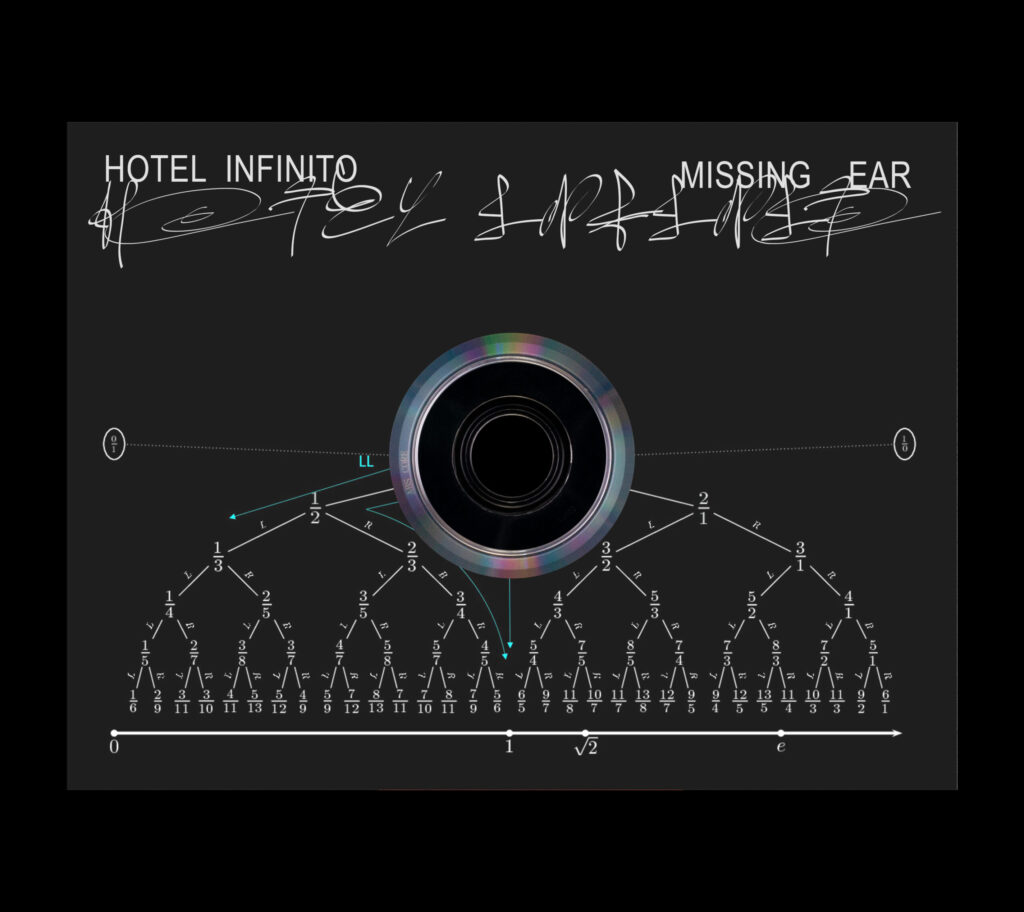
“Hotel Infinito” nasce dal paradosso matematico dell’hotel di Hilbert: quali elementi di questo concetto ti hanno ispirato maggiormente e come li hai tradotti nella struttura compositiva e narrativa del disco?
Ciò che mi ha colpito del paradosso di Hilbert è l’idea che una struttura già piena possa sempre fare spazio a qualcosa di nuovo, semplicemente riorganizzandosi. Ho visto subito una sorta di controcampo rispetto al tema degli Auditory Streams: non esiste una saturazione definitiva, c’è sempre un’ulteriore possibilità, o meglio una nuova scelta da compiere.
Ho trovato in questo una metafora molto precisa del mio approccio compositivo: ogni strato ritmico, ogni texture, ogni ambiente sonoro non chiude lo spazio, ma cerca di aprirlo e di immergere l’ascoltatore al suo interno.
Per questo motivo non penso al disco come a una narrativa lineare: è piuttosto una struttura che si riconfigura continuamente, proprio come l’hotel di Hilbert. Da Cyclo Threshold, il brano più denso, fino a Waiting For Godot, il più morbido e pulito, esiste una sorta di viaggio attraverso questa architettura sonora.
Nel tuo lavoro la batteria assume una funzione espansa, diventando anche spazio e materia sonora: come avviene il passaggio dalla registrazione acustica alla costruzione di architetture stratificate attraverso il processing digitale?
Il punto di partenza è quasi sempre una ritmica, che sia digitale, analogica o una registrazione acustica. Però spesso non la tratto semplicemente come una “ritmica”, ma come materia grezza.
Un colpo di rullante può diventare un drone, una risonanza può espandersi fino a trasformarsi in ambiente. Il processing digitale — e anche quello analogico, come la pedaliera che uso live per processare la batteria… spoiler: Death By Audio, JHS Pedals, Eventide… ma ovviamente la chain completa non la rivelo, bisogna venire ai live! — non è uno strato sovrapposto alla batteria: è il modo in cui la batteria continua a esistere oltre il momento dell’impatto fisico.
La rielaborazione digitale diventa poi il mezzo che mi permette di quantizzare tutto su una timeline e costruire una narrativa unica.
La tua ricerca integra riferimenti teorici come gli Auditory Streams e il pensiero di AUDINT: in che modo questi strumenti concettuali entrano concretamente nel tuo processo creativo e influenzano le scelte sonore?
Non li utilizzo come sistemi da applicare, ma come lenti attraverso cui osservare il suono. Gli Auditory Streams mi hanno aiutato a pensare alla percezione come a un processo attivo di selezione: il cervello non riceve semplicemente il suono, lo costruisce.
Questo ha cambiato il mio modo di comporre: lavoro con più piani simultanei che l’ascoltatore può scegliere di seguire o abbandonare. AUDINT invece introduce una dimensione più politica e corporea, in cui il suono attraversa il corpo prima ancora della mente.Entrambi alimentano la stessa domanda: cosa fa il suono al corpo e alla mente? E, sul piano performativo, cosa può fare il corpo con il suono?
Recentemente ho avuto il piacere di esibirmi dal vivo per PROIMION, spettacolo scritto e coreografato da Emma Scarafiotti, in coproduzione con Silent Art Explorer e Madame Collecte, prologo dell’art-film BACCANTI. Esibirmi nello spazio Fertilefertilefertile è stata un’esperienza speciale: un luogo in cui suono, corpi e spazio riescono davvero ad ascoltarsi reciprocamente. È stata solo la prima tappa di una collaborazione che mi ha permesso di approfondire molto il rapporto tra suono e corpo.
Le performer Katerina Karol, Dopo8tto e Xhelisabetta hanno interagito con una produzione sonora che mi ha consentito di indagare concretamente questa relazione.
Le tue composizioni si muovono tra ritmiche decostruite, texture elettroniche e suggestioni post-club: come affronti il processo di sperimentazione sonora per mantenere coerenza e riconoscibilità all’interno di un linguaggio così stratificato?
Credo che tutto dipenda dall’intenzione e dalla coerenza sonora: cerco di costruire un paesaggio sonoro riconoscibile al di là della forma che assume.Timeless Tamburo e Difficile, per esempio, sono due brani che in un certo senso si assomigliano molto, ma esplorano profondità differenti. Questo accade grazie a una tavolozza sonora affine che però si sviluppa in direzioni diverse.
Poi c’è una questione profondamente fisica: parto quasi sempre dal corpo, dalla batteria, da qualcosa che possiede un peso materiale. Anche l’artwork e il packaging riflettono questa idea: non più soltanto un vinile, ma un plate/gong metallico da 17 cm x 2 mm, con un suo peso specifico reale.
Anche lì ho cercato di riportare questa dimensione sperimentale, trasmettendo in ultima istanza il mio lato di batterista e ricercatore sonoro.
In “Hotel Infinito” il suono sembra configurarsi come uno spazio da attraversare: quale tipo di esperienza percettiva immagini per l’ascoltatore e come lavori per attivare una forma di consapevolezza attraverso l’ascolto?
Cerco di dare vita a un’esperienza il più completa possibile, e la collaborazione con la visual artist Alessandra Leone va esattamente in questa direzione.
Lavoro molto sulla spazializzazione: quando il suono si muove attorno a te, o ti attraversa, il corpo lo percepisce immediatamente. Lo stesso vale per la componente visiva proposta sul ledwall. È lì che si apre una modalità di ascolto diversa: più presente, più fisica.
In un momento storico in cui l’attenzione è la risorsa più contesa, chiedere a qualcuno di restare immerso in un suono per quaranta minuti è già di per sé un gesto significativo. Anche il live è pensato quasi come una successione di atti, per creare momenti e situazioni specifiche.
La collaborazione con la visual artist Alessandra Leone introduce una dimensione audiovisiva al progetto: come si sviluppa il dialogo tra suono e immagine e in che modo il contributo visivo espande il significato del lavoro?
Con Alessandra tutto è nato in modo molto naturale, anche se con tempi lunghi di gestazione — e credo sia giusto così per progetti di questo tipo. Avevamo iniziato anni fa a ipotizzare una collaborazione per 25AV, che poi si è trasformata in qualcosa di più ampio e articolato, fino a diventare Hotel Infinito.
Sono davvero felice di poter fare squadra con lei. Per rispondere meglio alla domanda: credo che il visual non spieghi il suono, e viceversa. I due linguaggi si amplificano reciprocamente, aprendo uno spazio che nessuno dei due potrebbe generare da solo, sia sul piano narrativo che su quello estetico.
Gli spazi reali e quelli generati tramite AI che si dissolvono l’uno nell’altro sono l’equivalente visivo di ciò che faccio con il suono: partire da qualcosa di “reale”, attraversare il dominio digitale e trasformarlo in altro. A breve porteremo fuori il live, quindi spero ci sarà occasione più che di parlarne, di viverlo direttamente.
Le tue performance si collocano in contesti molto diversi, tra club, istituzioni artistiche e festival internazionali: come adatti il tuo set e la tua presenza scenica in relazione allo spazio e alla tipologia di pubblico?
Lo spazio è sempre il primo interlocutore. Il set si adatta all’acustica, alla disposizione del pubblico, alla luce e a moltissimi altri fattori. È proprio questo che mi interessa: credo che un live modulabile abbia senso.
Un club e un’istituzione museale richiedono energie completamente diverse, non solo in termini di volume o densità ritmica, ma anche nel ritmo narrativo dell’esibizione, nel modo in cui costruisci e rilasci la tensione.
Ho suonato al NewNow Festival con Katatonic Silentio, al Dongdaemun Design Plaza accanto agli Otolab, e al Museo della Permanente prima di Hudson Mohawke: ogni contesto ha richiesto una lettura differente.
L’identità del progetto non cambia, ma si modula per raggiungere le persone nel modo più adatto possibile. Questo non significa che non esista una formula del live: significa semplicemente che esistono molteplici possibilità di fruizione, ed è proprio questo il bello.
Con l’uscita di “Hotel Infinito” si apre una nuova fase del tuo percorso: quali direzioni di ricerca immagini per il futuro e quali aspetti del progetto senti ancora in evoluzione?
Prima di guardare troppo avanti, sento il bisogno di sviluppare pienamente questo progetto: dal live alla diffusione attraverso talk e presentazioni che stanno per concretizzarsi. Abbiamo diverse cose in cantiere, ma finché non saranno ufficiali preferisco aspettare.Ho capito che dal mondo audiovisivo non potrò più tornare indietro, sia per percorso personale sia per scelta artistica. Lo stesso vale per la batteria. Però ci sono ancora moltissimi orizzonti sonori che voglio esplorare.
Ci sono realtà che mi interessano molto, come Krisis Publishing, i progetti di LOREM, oppure OUS, che pubblica sempre lavori molto curiosi. Mi interessano artisti come Simon Grab e Noemi Büchi, ma anche mondi più distanti come i Moin su AD93, Marina Herlop su PAN e le uscite di Subtext Records.
Ovviamente Oneohtrix Point Never su WARP resta un riferimento fondamentale a livello sonoro, così come Kangding Ray o Atom TM su Raster.
ENGLISH VERSION
Missing Ear, alias of Italian experimental drummer and sound designer Matteo Gualeni, returns with “Hotel Infinito”, an album that further expands his research into sound and perception.
Missing Ear design in his music an immersive sonic universe in which the drum kit becomes living matter, environment, and perceptual device. Inspired by Hilbert’s “infinite hotel” paradox, the record reflects an understanding of composition as a continuously expanding structure, capable of endlessly accommodating and reorganising new sonic elements, moving between deconstructed rhythms, electronic textures, and spatial architectures.
Milan-based artist active across live performance, production, and sound design, Missing Ear develops a practice that often begins with acoustic drum recordings, which are then transformed through both digital and analogue processes into layered, continuously mutating soundscapes. His work sits at the intersection of post-club experimentation, electronic music research, and sound art, drawing references that range from IDM to more physical and corporeal approaches to sound.
In this interview with Missing Ear, we discussed his key theoretical and musical inspirations, the central role of listening as an active and immersive experience, the process of sound construction between physical gesture and digital manipulation, and the development of a fully realised audiovisual project in collaboration with visual artist Alessandra Leone. The conversation also explores the relationship between live performance, space, and perception, outlining an artistic trajectory in which sound becomes a total experience.
Hello Missing Ear, welcome back to Parkett. Your project is based on the idea of listening as an active and immersive experience: how has this vision developed over time, and how does it manifest today in your artistic and performative practice?
It’s a vision that has been built through accumulation rather than a single turning point. I come from a jazz and acoustic background, so the body has always been central: the drums are first of all anything a physical instrument, and that’s precisely what makes me love them more than any other instrument.
Over time I started questioning what happens between sound and the listener: listening is never passive, even when it appears to be. Readings such as Unsound/Undead by AUDINT or studies on Auditory Streams gave a theoretical language to something I had already been intuitively perceiving.
Today this vision runs through everything I do: from mixing choices to the structure of performances, to how I conceive the relationship between live and studio. I want the performance to allow one to inhabit sonic space. Last year’s residency at Casa degli Artisti in Milan helped me gain deeper awareness of this approach and also led me to build handmade instruments that I now use live.
“Hotel Infinito” is based on the mathematical paradox of Hilbert’s Hotel: which elements of this concept inspired you most, and how did you translate them into the compositional and narrative structure of the record?
What struck me about Hilbert’s paradox is the idea that a structure already full can always make room for something new, simply by reorganizing itself. I immediately saw it as a kind of counterpoint to the theme of Auditory Streams: there is no final saturation, there is always an additional possibility, or rather a new decision to be made.
I found in this a very precise metaphor for my compositional approach: every rhythmic layer, every texture, every sonic environment does not close space, but tries to open it and immerse the listener within it.
For this reason I don’t think of the album as a linear narrative: it is rather a structure that continuously reconfigures itself, just like Hilbert’s Hotel. From Cyclo Threshold, the densest track, to Waiting For Godot, the softer and cleaner one, there is a kind of journey through this sonic architecture.
In your work the drums take on an expanded function, becoming both space and sonic matter: how does the transition happen from acoustic recording to the construction of stratified digital architectures?
The starting point is almost always a rhythm, whether digital, analogue, or an acoustic recording. But I often don’t treat it simply as a “rhythm,” but as raw matter.A snare hit can become a drone; a resonance can expand until it turns into an environment. Digital processing—and also analogue processing, such as the pedalboard I use live to process drums… spoiler: Death By Audio, JHS Pedals, Eventide… but of course I won’t reveal the full chain, you have to come to the live shows!—is not a layer added on top of the drums: it is the way the drums continue to exist beyond the moment of physical impact.
Digital reworking then becomes the means that allows me to quantize everything onto a timeline and build a unified narrative.
Your research integrates theoretical references such as Auditory Streams and the thinking of AUDINT: how do these conceptual tools concretely enter your creative process and influence your sonic choices?
I don’t use them as systems to be applied, but as lenses through which to observe sound. Auditory Streams helped me think of perception as an active process of selection: the brain does not simply receive sound, it constructs it.
This changed the way I compose: I work with multiple simultaneous layers that the listener can choose to follow or abandon. AUDINT, on the other hand, introduces a more political and bodily dimension, in which sound passes through the body before even reaching the mind.Both feed the same question: what does sound do to the body and the mind? And, on a performative level, what can the body do with sound?
Recently I had the pleasure of performing live for PROIMION, a show written and choreographed by Emma Scarafiotti, in co-production with Silent Art Explorer and Madame Collecte, a prologue to the art film BACCANTI. Performing at Fertilefertilefertile was a special experience: a space where sound, bodies, and space truly manage to listen to each other.It
It was only the first step of a collaboration that allowed me to further investigate the relationship between sound and body. The performers Katerina Karol, Dopo8tto, and Xhelisabetta interacted with a sonic production that allowed me to concretely explore this relationship.
Your compositions move between deconstructed rhythms, electronic textures, and post-club suggestions: how do you approach sonic experimentation while maintaining coherence and recognisability within such a stratified language?
I think it all depends on intention and sonic coherence: I try to construct a recognisable soundscape beyond the form it takes.Timeless Tamburo and Difficile, for example, are two tracks that in a sense are very similar, but they explore different depths. This happens thanks to an aligned sonic palette that develops in different directions.
Then there is a deeply physical question: I almost always start from the body, from the drums, from something that has material weight. Even the artwork and packaging reflect this idea: no longer just a vinyl, but a 17 cm × 2 mm metal plate/gong, with a real physical weight.
There too I tried to bring in this experimental dimension, ultimately conveying my side as both drummer and sound researcher.
In “Hotel Infinito” sound seems to be configured as a space to be traversed: what kind of perceptual experience do you imagine for the listener, and how do you work to activate a form of awareness through listening?
I try to create the most complete experience possible, and the collaboration with visual artist Alessandra Leone goes exactly in that direction.I work a lot on spatialisation: when sound moves around you, or through you, the body perceives it immediately. The same applies to the visual component presented on the LED wall. That is where a different mode of listening opens up: more present, more physical.
In a historical moment in which attention is the most contested resource, asking someone to remain immersed in sound for forty minutes is already a meaningful gesture. Even the live performance is designed almost as a sequence of acts, to create specific moments and situations.
The collaboration with visual artist Alessandra Leone introduces an audiovisual dimension to the project: how does the dialogue between sound and image develop, and in what way does the visual contribution expand the meaning of the work?
With Alessandra everything began very naturally, even though it required a long gestation period—and I think that’s right for projects like this. We had started years ago imagining a collaboration for 25AV, which then evolved into something broader and more articulated, eventually becoming Hotel Infinito.
I’m truly happy to be teaming up with her.To answer more directly: I don’t think the visual explains the sound, nor does the sound explain the visual. The two languages amplify one another, opening a space that neither could generate alone, both on a narrative and aesthetic level.
Real spaces and AI-generated spaces dissolving into one another are the visual equivalent of what I do with sound: starting from something “real,” passing through the digital domain, and transforming it into something else.We will soon bring the live performance out, so I hope there will be a chance not just to talk about it, but to experience it directly.
Your performances take place in very different contexts, from clubs to art institutions to international festivals: how do you adapt your set and stage presence in relation to the space and the audience?
Space is always the first interlocutor. The set adapts to acoustics, audience layout, lighting, and many other factors. That’s exactly what interests me: I believe a modular live performance makes sense.A club and a museum institution require completely different energies, not only in terms of volume or rhythmic density, but also in the narrative pacing of the performance, in the way tension is built and released.
I’ve played at the NewNow Festival with Katatonic Silentio, at Dongdaemun Design Plaza alongside Otolab, and at Museo della Permanente before Hudson Mohawke: each context required a different reading.The identity of the project does not change, but it modulates itself to reach people in the most appropriate way. This does not mean there is no “formula” for the live set: it simply means there are multiple possible modes of reception, and that is precisely the beauty of it.
With the release of “Hotel Infinito” a new phase of your path opens up: which directions of research do you imagine for the future, and which aspects of the project still feel in evolution?
Before looking too far ahead, I feel the need to fully develop this project: from the live set to dissemination through talks and presentations that are about to materialise. We have several things in the pipeline, but until they are official I prefer to wait.I have understood that I will no longer be able to go back from the audiovisual world, both for personal trajectory and artistic choice. The same applies to the drums. But there are still many sonic horizons I want to explore.
There are labels and platforms that interest me a lot, such as Krisis Publishing, LOREM projects, or OUS, which consistently releases very curious works. I’m interested in artists like Simon Grab and Noémi Büchi, but also in more distant worlds such as Moin on AD93, Marina Herlop on PAN, and releases on Subtext Records.Of course Oneohtrix Point Never on WARP remains a fundamental sonic reference, as well as Kangding Ray or Atom TM on Raster.