
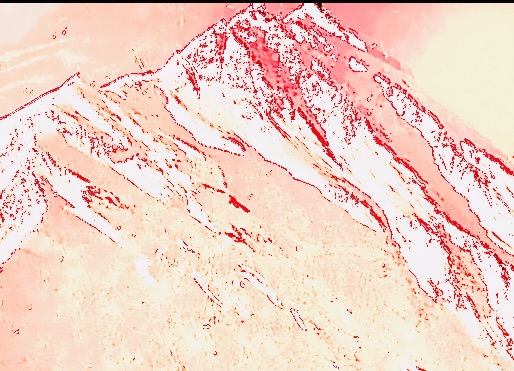
Mountains of Heaven arrive with Mountains of Heaven 1 and 2 as a statement that feels less like a debut and more like a terrain already lived in. Conceived and performed by Rick Guistolise, the project unfolds as a wide, slow-moving mass of sound where drone and alternative rock are not opposing forces but parts of the same geological process. The album was recorded in Ohio, in a secluded studio environment, and that sense of isolation seeps into the music, shaping its scale and its patience.
The most striking element is the way rhythm operates. Drums rarely function as a simple backbone; instead, they push and pull the tracks forward with a physical insistence. On pieces like “Brilliant Massive Stones” and “Of Sound,” the percussion lands heavy and deliberate, almost ritualistic, anchoring the surrounding haze. The grooves feel discovered rather than designed, which aligns with the album’s real-time, improvised recording approach. There are moments where the rhythm locks into a hypnotic loop, then loosens unexpectedly, allowing the track to breathe before regaining momentum. This constant negotiation between control and release gives the album a living pulse.
Bass plays an equally important role, often sitting thick and close to the listener, adding weight rather than complexity. Its presence reinforces the album’s physicality, grounding the more abstract elements. At times the bass becomes the central narrative voice, particularly in tracks like “Pink Bass Happening,” where repetition and subtle variation create a slow-burning tension. It is not flashy, but it is essential, acting as the connective tissue between rhythm and atmosphere.
Synths and drones shape the album’s emotional architecture. Rather than dominating the mix, they hover, stretch, and dissolve, filling negative space with long tones and blurred harmonics. These textures recall minimalist drone traditions while remaining firmly embedded in a rock framework. On tracks such as “Music and Laughing” and “Imperilous,” the synth layers feel almost weather-like, drifting in and out, softening the edges of the guitars. The result is an immersive environment that invites sustained listening rather than quick consumption.
Guitars move fluidly between distortion and restraint. There are clear echoes of post-rock and loudgaze traditions, but they are filtered through a personal lens. Walls of sound rise and recede, sometimes collapsing into near silence before surging again. “Armor” and “Let’s Have Some Life, eh” showcase this dynamic range particularly well, balancing aggression with introspection. The improvisational origins of the material are audible in the way melodies seem to emerge mid-flight, not fully resolved, yet emotionally convincing.
Atmosphere is where Mountains of Heaven 1 and 2 fully asserts itself. The album flows like a single extended journey, designed to be played from start to finish. There is a cinematic quality throughout, but it avoids obvious climaxes. Instead, moods shift gradually: from bombastic and expansive to hazy and reflective, then back again. The closing tracks, “Banquet” and “Saudade,” lean into melody and restraint, offering a sense of closure without neat resolution. They feel like an exhale after a long ascent.
What ultimately distinguishes this release is its confidence in scale and intention. By constructing the album live, without pre-written material, Mountains of Heaven embrace uncertainty as a creative tool. That spontaneity translates into music that feels immediate yet carefully balanced, raw but cohesive. It is an album that accommodates different states of listening, whether focused or peripheral, active or meditative.
Mountains of Heaven 1 and 2 stands as a high-quality release that rewards repeated engagement. Its blend of heavy rhythm, immersive synth work, and evolving atmosphere positions it comfortably within the drone and alternative rock continuum while carving out its own space. It is a body of work that feels complete, expansive, and quietly ambitious, one that we are pleased to host and explore within the pages of our webzine.