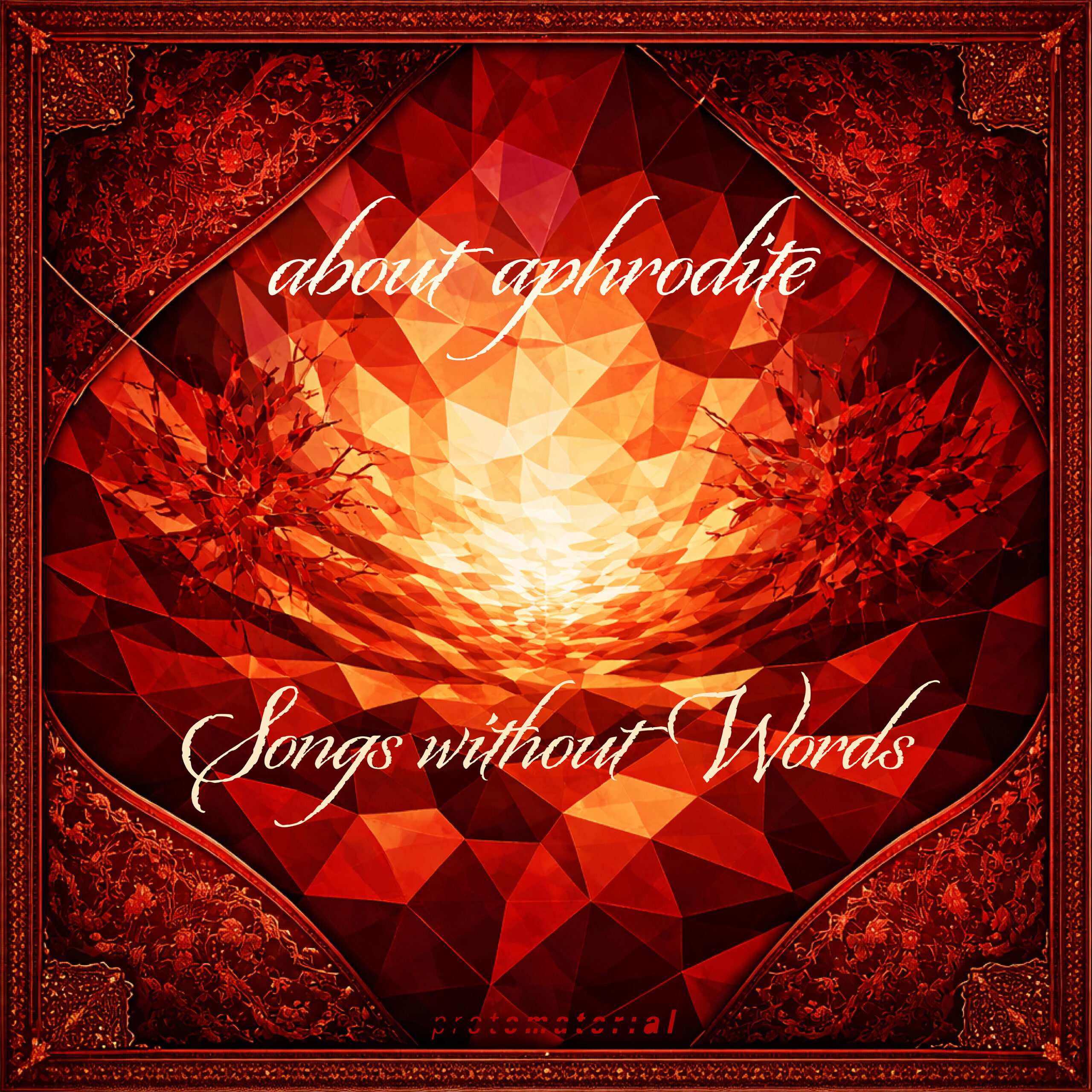

A record that feels less like a collection of compositions and more like a shifting geography of sound, Songs Without Words positions About Aphrodite in a space where jazz intuition and electronic architecture blur into a single language. Across its unfolding, the album resists fixed identity, instead leaning into movement, ambiguity, and a kind of quiet emotional drift that rarely settles in one place for too long. What emerges is a work shaped by contrast: intimacy and distance, structure and improvisation, tradition and synthetic abstraction coexisting without forcing resolution.
The rhythmic foundation of the album is deliberately unstable in a way that feels organic rather than conceptual. Beats are rarely foregrounded in a conventional sense; instead, they appear as pulses, interruptions, or subtle gravitational pulls beneath the surface. Electronic textures often behave like air currents, reshaping the harmonic space without dominating it. At times, the jazz influence surfaces through phrasing and timing rather than overt swing, creating a sense of suspended motion. The synth work, in particular, avoids predictability, favoring evolving tonal layers that stretch and dissolve rather than repeat.
Instrumentation plays a central role in defining the emotional temperature of the record. Gilda Razani’s theremin and soprano saxophone introduce two distinct registers of expression: one almost vocal, wavering and spectral, the other grounded yet capable of sudden vulnerability. Hanzō Wanning builds the harmonic framework through piano and synthesizers, alternating between acoustic warmth and electronic depth in a way that never feels binary. When Fethi Ak’s darbuka enters the picture, the rhythmic space expands further, adding a tactile, almost earthbound resonance that contrasts sharply with the floating upper layers. The trio configuration, when present, feels less like an arrangement choice and more like a conversation that shifts its own rules mid-sentence.
Across the six pieces, the album draws from a wide cultural and musical spectrum without reducing it to collage. Persian melodic references surface in fragmented forms, often embedded within broader improvisational gestures rather than presented as thematic statements. Tracks such as “Sartschubeh” and “Newrusi Cats” reflect this approach clearly, where cultural memory is not illustrated but subtly echoed. “Loretta’s Sinfonia” and “Heroine of the Night” lean into duality, unfolding in movements that suggest narrative without fully committing to linear storytelling. “Taraneh” carries a more intimate emotional charge, while “Reverie” dissolves the album into a softer, almost weightless conclusion.
What ties everything together is a shared sensitivity to space. Silence is treated as an active component rather than absence, and the music often feels as though it is listening to itself as much as it is being performed. The interplay between acoustic and electronic elements never resolves into hierarchy; instead, each texture seems to adjust its presence in response to the others. This constant recalibration gives the album a living quality, as if it were being composed in real time even in its most structured moments.
Songs Without Words stands as a release of high quality, one that we are pleased to host and review on our webzine. It is not an album that demands immediate understanding, nor does it rely on recognisable climaxes or familiar genre markers. Instead, it invites a slower form of attention, one that rewards repeated listening with subtle shifts in perception. In its refusal to settle, it finds a quiet strength, offering a listening experience that feels both distant and deeply personal at once.