
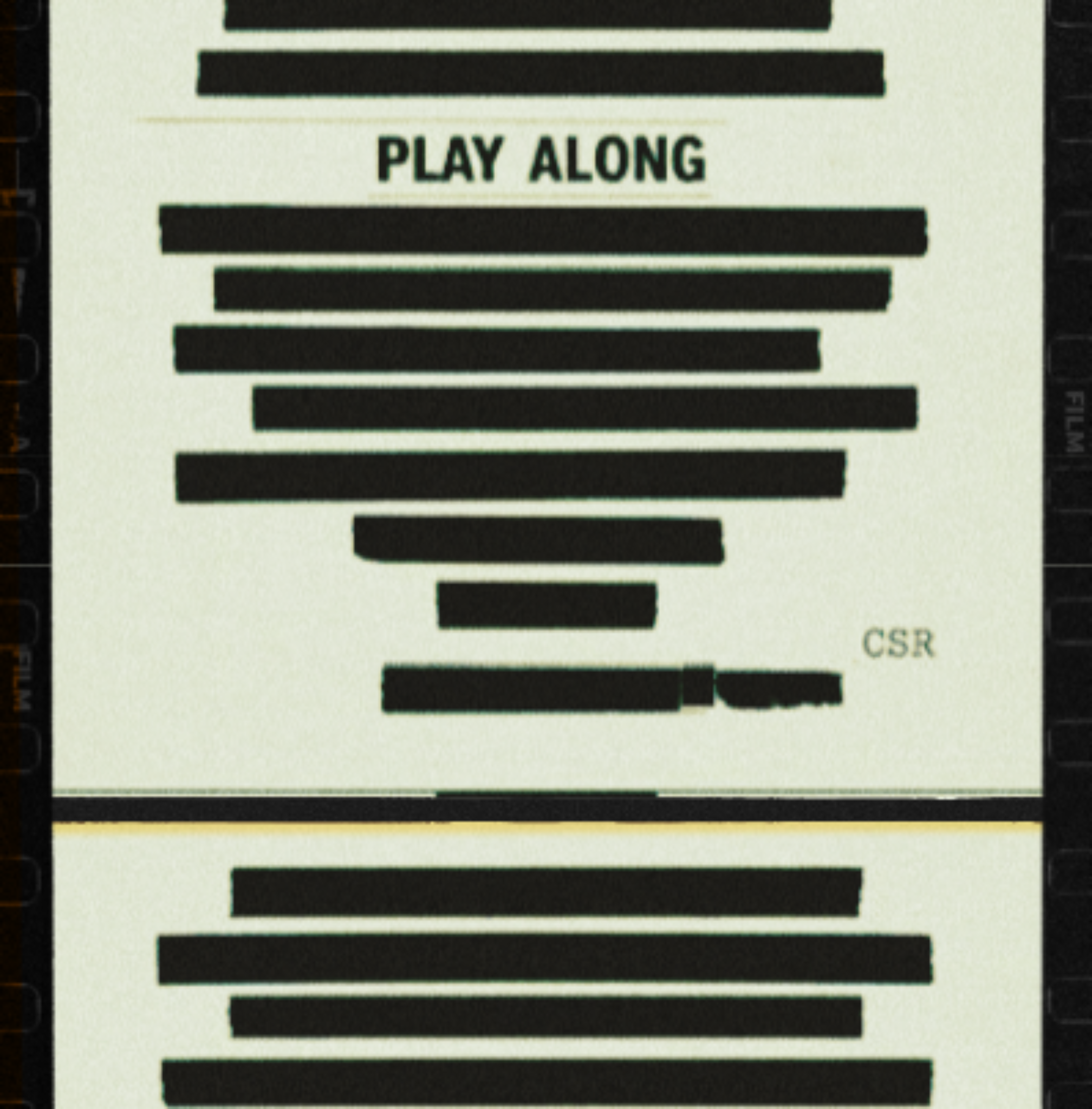
“PLAY ALONG” unfolds as a controlled, deliberate statement, one that favors pressure over release and tension over catharsis. Rather than relying on dramatic turns or overt gestures, the track moves forward with a sense of contained momentum, carefully calibrated and emotionally reserved. It sits comfortably within the darker edges of electronic music, borrowing from post-punk and dark wave traditions while avoiding nostalgia or stylistic pastiche. The result is a piece that feels present, alert, and quietly confrontational.
From the opening moments, rhythm establishes itself as the track’s backbone. The tempo is steady, almost inflexible, creating a mechanical pulse that never fully relaxes. This rhythmic insistence is not aggressive, but persistent, functioning less as a driver of excitement and more as a framework of endurance. The beat does not escalate toward a climax; instead, it maintains a consistent forward motion, reinforcing the song’s themes of compliance, pressure, and the long-term weight of institutional systems. Small variations in texture and emphasis become meaningful precisely because the core rhythm refuses to shift.
Synth work in “PLAY ALONG” is intentionally minimal, yet sharply focused. Rather than lush pads or melodic hooks, the track leans on restrained, often cold tonal elements. The synthesizers hover in narrow frequency ranges, repeating motifs with slight modulation, as if circling an unresolved thought. This approach heightens the sense of unease: the listener is never given a melodic release, only a series of controlled signals that accumulate over time. The sound design feels purposeful, stripped of excess, and aligned with the track’s refusal to offer comfort.
Atmospherically, the song operates in a nocturnal register. There is a strong sense of late-night isolation running through the arrangement, a mood that feels urban but not cinematic. Los Angeles is present less as a visual setting and more as an underlying energy—restless, anonymous, and infrastructural. The anonymity of the project reinforces this atmosphere, allowing the track to function as a voice without a face, an observation rather than a confession. The darkness here is not theatrical; it is procedural, routine, and therefore more unsettling.
Lyrically, “PLAY ALONG” addresses political and social themes without slogans or explicit declarations. The focus is on quiet resistance and the psychological toll of sustained compliance. Lines feel deliberately understated, almost observational, reflecting a mindset shaped by managed narratives and withheld truths. This restraint mirrors the sonic architecture of the track: nothing is overstated, yet everything carries weight. The listener is left to connect the dots, to sit with implications rather than messages.
The artwork associated with the release extends these ideas visually. By referencing public redaction culture, it echoes the song’s concern with omission, control, and selective visibility. Just as information is obscured or censored, the track withholds emotional release and narrative clarity. Sound and image work together, reinforcing a cohesive artistic statement that values coherence over immediacy.
In the broader context of dark wave and electronic releases, “PLAY ALONG” distinguishes itself through discipline. It resists the temptation to lean into uplift, hooks, or dramatic payoff. Instead, it commits fully to mood and continuity, making it particularly suited to curator-driven playlists that prioritize atmosphere and flow. The track does not demand attention; it earns it gradually, through consistency and intent.
“PLAY ALONG” stands as a high-quality release, defined by its focus and clarity of vision. It is a track that understands the power of limitation, using minimal tools to articulate complex emotional and political undercurrents. By choosing restraint over excess, Cable Street Riot delivers a piece that lingers not because of what it gives, but because of what it withholds—an approach that feels both deliberate and deeply in tune with its themes.