
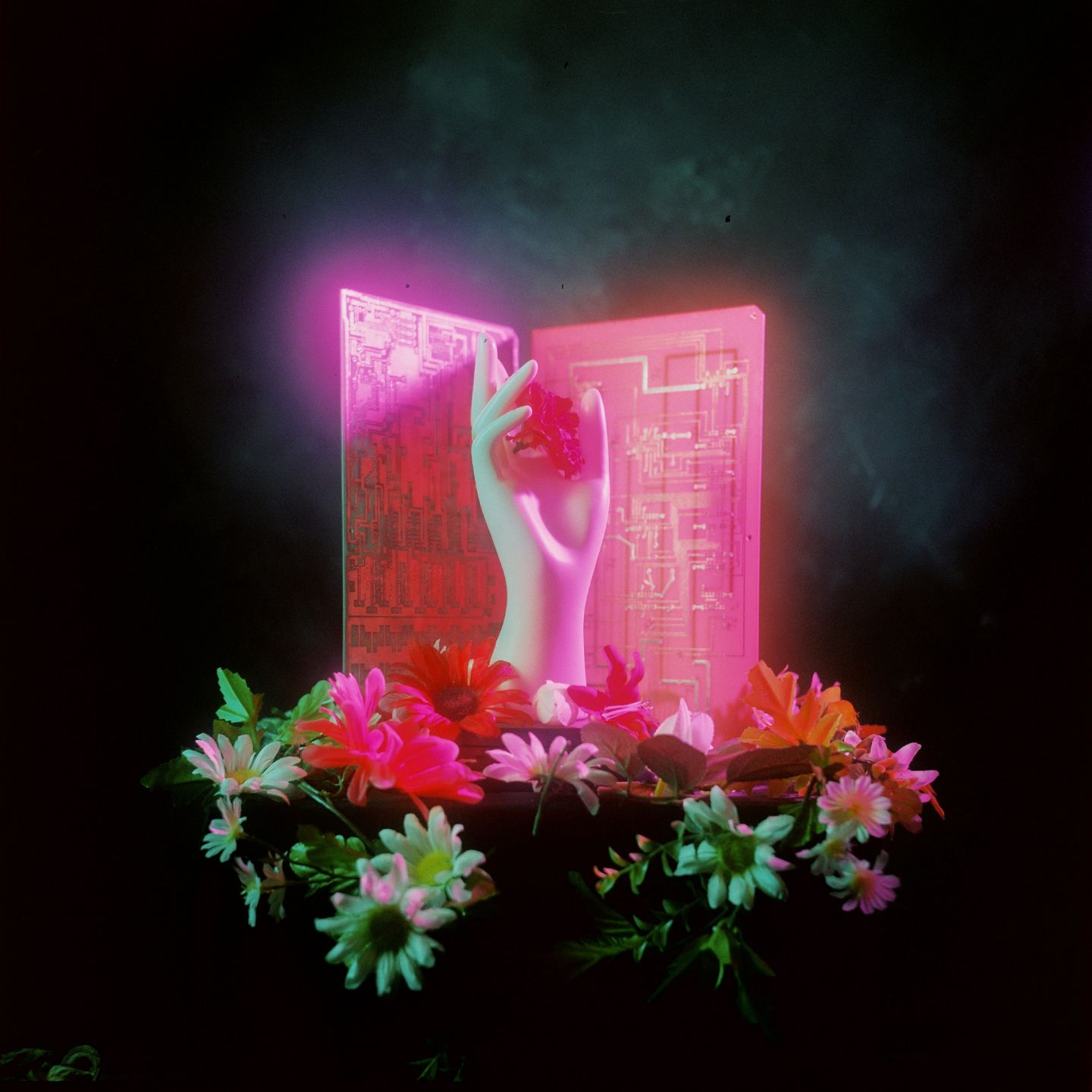
There is a quiet tension running through Hold, the new release by Hyperflower, a duo formed by Lorenzo Setti (also known for the ATŌMI project) and Irene Cavazzoni Pederzini. The track unfolds slowly, almost cautiously, as if testing the emotional space it occupies. From the first seconds it becomes clear that this is not a conventional electronic composition. Instead, Hold operates somewhere in the fluid territory between experimental electronic music, fragile pop structures, and a kind of reflective sonic minimalism that allows atmosphere to speak as much as melody.
At its core, the track seems to revolve around the idea of self-recomposition. The narrative suggested by the lyrics is subtle but present: a body and mind attempting to gather themselves after a moment of emotional depletion. It is not dramatized suffering, though. Rather, the piece lingers in the suspended state that follows a rupture — a moment where exhaustion and warmth coexist, where the act of holding oneself together becomes both literal and symbolic.
Musically, the rhythmic structure immediately establishes this sense of instability. The beat rarely settles into a fully predictable grid. Instead, it feels slightly displaced, as if the rhythmic backbone of the track shifts a few millimeters to the left or right at unexpected moments. Percussive elements appear and dissolve in restrained patterns, creating an irregular pulse that gives the composition its breathing quality. The rhythm does not push forward aggressively; it hovers. At times it resembles a slow mechanical heartbeat, while at others it becomes almost absent, leaving space for the surrounding textures to take the foreground.
The synth work is perhaps the most defining aspect of the piece. Hyperflower build their sound palette through layers of delicate, almost translucent tones. Some of these textures carry a distinctly retro-digital character — reminiscent of early digital synthesis — yet they are arranged in a way that feels contemporary and slightly futuristic. Soft pads drift across the stereo field, occasionally interrupted by sharper, glass-like tones that punctuate the arrangement without overwhelming it.
There is a strong sense of movement inside these synth layers, even when the harmony itself remains relatively minimal. Tones expand, contract, and slowly dissolve into each other, producing a shifting landscape that never quite repeats itself in the same way. The production approach emphasizes air and space; silence becomes part of the composition. Each element seems carefully positioned so that nothing fully dominates the mix.
Vocally, Irene Cavazzoni Pederzini’s delivery reinforces the introspective dimension of the track. Her voice remains restrained, almost intimate, floating above the instrumentation rather than cutting through it. The lyrics themselves follow a mantra-like structure, repeating key phrases in a cyclical pattern. This repetition is not merely structural; it functions as an emotional anchor within the otherwise fluid composition.
Lines such as “Feel my muscles / melting embers” or “Like a night falling into the sunrise” suggest images of gradual transformation, where exhaustion slowly shifts toward a fragile sense of renewal. The recurring word “hold” becomes both instruction and comfort, repeated until it begins to feel less like language and more like rhythm.
This cyclical melodic approach gives the track its peculiar architecture. Instead of building toward a traditional climax, Hold moves through a series of subtle variations. Familiar elements reappear but are placed in slightly altered contexts — sometimes surrounded by denser synth textures, other times almost stripped bare. These shifts create different emotional “rooms” within the same sonic structure, allowing the listener to drift between moments of immersion and distance.
The mixing by Davide Cristiani plays an important role in maintaining this delicate balance. The sonic field remains wide and breathable, allowing each layer to exist without collapsing into a dense electronic wall. Meanwhile, the mastering by Andrea “Berni” De Bernardi preserves the track’s dynamic subtleties, avoiding excessive compression and letting the quieter passages retain their fragility.
Taken as a whole, Hold reflects the aesthetic direction that Hyperflower seem to be cultivating: a meeting point between experimental exploration and understated melodic sensibility. Their ability to merge alternative electronic textures with a restrained pop instinct results in a sound that feels both intimate and slightly otherworldly.
It is a thoughtful, carefully shaped release — one that rewards attentive listening and gradual immersion. For a webzine dedicated to forward-thinking electronic music, Hold represents exactly the kind of nuanced and emotionally resonant work that deserves space and attention.