
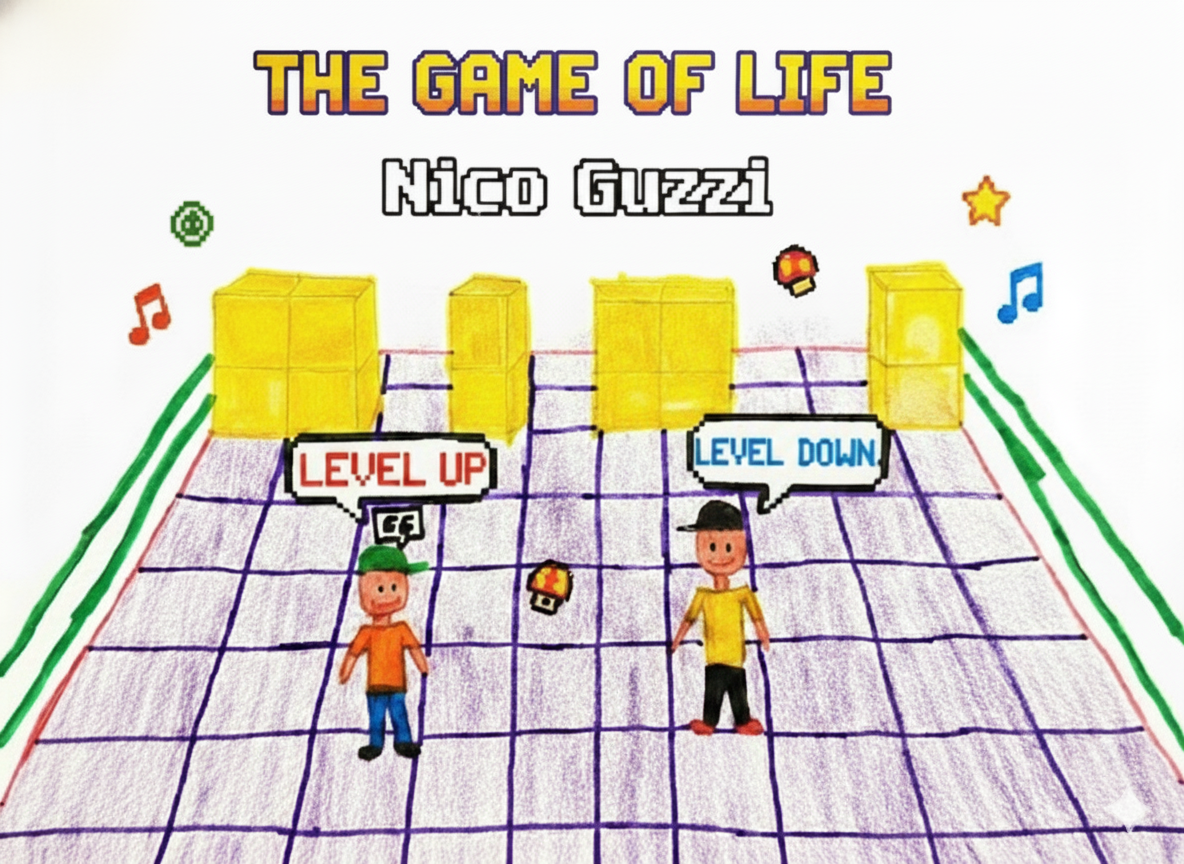
Nico Guzzi’s The Game of Life unfolds as a carefully layered statement, one that resists easy categorization while remaining immediately legible in its emotional intent. Framed within electronic pop and groove, the album stretches well beyond those labels, operating instead as a hybrid space where classical language, club-oriented electronics, and spoken or rapped vocals coexist without hierarchy. Across its nine tracks, released on January 15, 2026, the record proposes a sonic narrative that mirrors the contradictions of contemporary life: accelerated, distracted, ironic, and yet persistently searching for meaning.
From the opening moments, rhythm plays a central role. Guzzi avoids static beats, favoring patterns that shift and breathe, sometimes grounded in dancefloor logic, sometimes pulling back into more cinematic pacing. Groove is present, but rarely predictable. Percussive elements often feel slightly displaced, creating a sense of forward motion that never fully settles. This rhythmic instability reflects the album’s thematic core, a world in constant update, where momentum replaces direction. Even in the more accessible passages, there is a subtle friction between pulse and melody that keeps the listener alert.
The synth work is equally deliberate. Rather than leaning on a single palette, The Game of Life moves through contrasting textures: warm analog tones, sharp digital stabs, expansive pads, and basslines that occasionally tip into dubstep territory. These electronic elements are not presented as spectacle but as structural components, often intertwined with orchestral writing. Strings, double basses, and harmonic arrangements drawn from classical tradition appear throughout the album, sometimes in the foreground, sometimes woven into the background until they almost disappear. The result is a constant dialogue between the organic and the artificial, neither side overpowering the other.
Atmospherically, the album operates on multiple levels. There is a clear sense of urban modernity, reinforced by lyrical references to digital culture, status symbols, and collective fatigue. At the same time, many tracks carry a reflective, almost elegiac tone, as if observing this environment from a slight distance. Songs such as “Loser” adopt satire as a narrative tool, using irony to highlight emotional emptiness beneath surfaces of success and connectivity. Elsewhere, the mood shifts toward something more expansive and aspirational, suggesting escape, transcendence, or at least a pause from the constant noise.
Vocally, Guzzi moves fluidly between melodic phrasing and rap-inflected delivery, treating the voice as another instrument rather than a fixed focal point. This flexibility allows the album to navigate different emotional registers without breaking coherence. In tracks like “Follow Me Now,” the voice carries a heavier dramatic weight, supported by orchestral tension and electronic pressure that mirror the song’s themes of struggle and impermanence. In contrast, more groove-oriented moments lean into repetition and cadence, reinforcing the hypnotic quality of the production.
What stands out across The Game of Life is its structural awareness. The album is sequenced as a journey rather than a collection of singles, with recurring motifs and emotional echoes that connect the tracks. Themes of existential apathy, digital alienation, and the desire for personal liberation reappear in different forms, giving the record a sense of internal conversation. References to being “barely present” or lost within artificial systems are not presented as conclusions, but as starting points for questioning.
This sense of inquiry aligns with Guzzi’s broader artistic background, which spans composition, songwriting, and literary work. His experience across disciplines is audible in the album’s balance between concept and execution. The production is detailed without feeling overworked, allowing imperfections and contrasts to remain visible. There is no attempt to smooth everything into uniformity; instead, the album accepts unevenness as part of its identity.
The Game of Life ultimately positions itself as a genre-fluid reflection of its time, one that invites both movement and contemplation. It is a release of clear quality and intention, capable of engaging listeners on multiple levels, from rhythmic immersion to thematic reflection. For a webzine attentive to contemporary electronic and hybrid music, hosting this album with a dedicated review feels not only appropriate, but necessary, as it captures a restless, searching energy that defines much of today’s musical and cultural landscape.