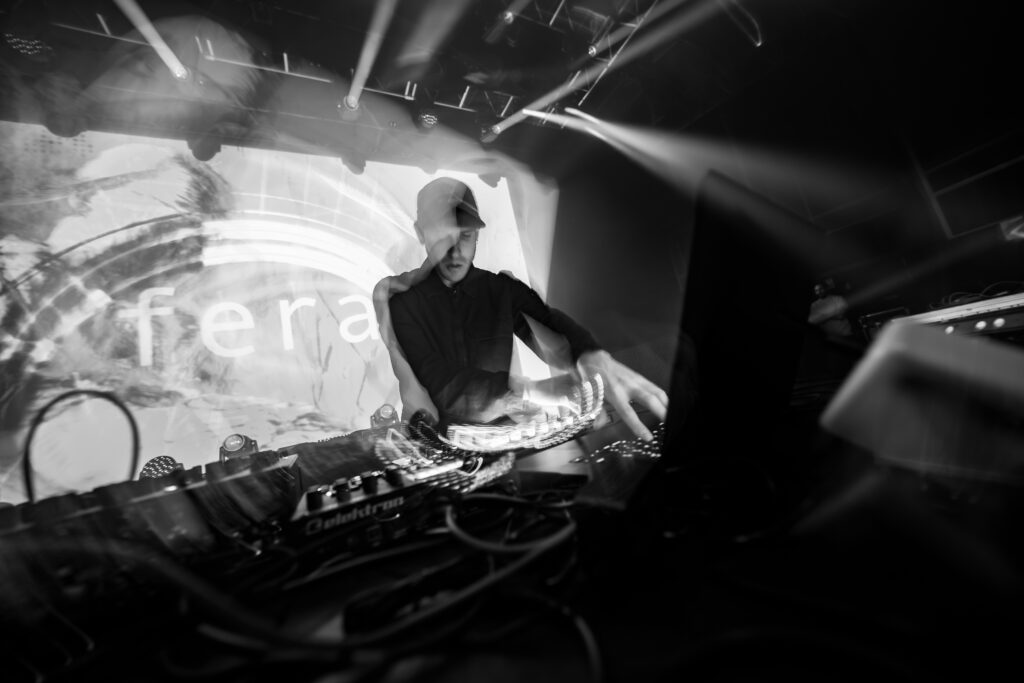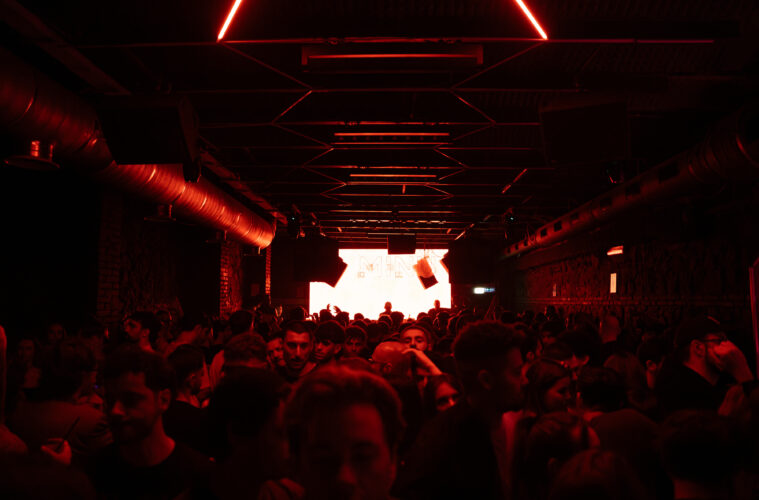
In vista del loro primo live insieme a Roma il 26 dicembre al Rashomon, abbiamo incontrato Luigi Tozzi e Feral per una conversazione sul live come pratica, sul rapporto tra suono e spazio e su un’idea di techno che mette il processo prima del risultato, all’interno dell’ecosistema sonoro di Hypnus Records.
Luigi Tozzi e Feral (Alessandro Barchitta) hanno costruito negli ultimi anni percorsi paralleli all’interno della musica elettronica, muovendosi tra techno ipnotica, ambient e performance live, con un’attenzione costante allo spazio, alla profondità del suono e al processo più che al risultato. Entrambi cresciuti artisticamente a Roma e legati all’etichetta Hypnus Records, hanno sviluppato linguaggi distinti ma complementari: da un lato l’approccio narrativo, stratificato di Luigi, dall’altro la dimensione più rituale e percussiva di Feral. Questa conversazione nasce dall’esperienza condivisa alla Sunday Ceremony di Zero BPM ad Amsterdam, un contesto lontano dal formato club tradizionale, e si muove tra riflessioni sul live come pratica, sul rapporto tra suono e spazio, sull’evoluzione dell’identità sonora e sul ruolo della comunità attorno all’etichetta svedese Hypnus. L’intervista si chiude guardando al primo live insieme che si terrà a Roma, il 26 dicembre. Un ritorno nella città in cui entrambi operano e da cui, in modi diversi, hanno fatto partire il proprio percorso.
Ciao ragazzi, ho visto che ultimamente state portando in giro i vostri live e mi è capitato di vedere alcune immagini del Zero BPM: Sunday Ceremony ad Amsterdam, dove avete suonato entrambi. Sembrava uno spazio decisamente diverso dal solito contesto da club. Com’è andata?
Feral
L’impostazione era decisamente diversa rispetto a una serata normale, che fosse club o ambient. L’evento si è svolto in una cappella riconvertita in una sorta di auditorium, con un organo pazzesco al centro dello spazio. L’impianto era in quadrifonia, e il pubblico sedeva in cerchio attorno ad una persona che meditava nel mezzo. Ad ogni cambio di set, le persone uscivano e rientravano, cosa che ha reso il ritmo scandito e molto disciplinato. Non si poteva stare sdraiati e questa cosa, personalmente, l’ho trovata positiva. C’erano molte regole, ma sono servite a spingere il pubblico verso un ascolto più profondo. Ed è raro, oggi, trovare contesti in cui la gente stia davvero lì, concentrata sulla musica. In quell’ora, le persone erano presenti, attente e immerse nell’ascolto.
Luigi
Personalmente, quella rigidità non mi ha fatto impazzire. Mi piacerebbe che certi comportamenti venissero dal buon senso delle persone, senza dover imporre delle regole. Però capisco che, nella realtà, non è quasi mai così. Quindi ogni tanto qualche linea guida serve.
Quanto incide il luogo e il suo spazio nella costruzione di un live?
Feral
Il luogo è importantissimo così come l’impianto audio, anche se poi tutto diventa un’estensione della musica. Non facciamo musica su misura per un luogo, ma scegliamo una scaletta diversa a seconda del contesto. Se suoni in un club da milleduecento persone o in un festival, cambia tutto. Dipende dall’orario, dal pubblico, da quello che ci viene chiesto. Il nostro approccio resta sempre lo stesso, ma è il contesto che modula l’intenzione.
Luigi
È completamente diverso. In un live ambient come quello di Amsterdam non hai la reazione diretta del pubblico, quindi devi immaginarla. Non stai interpretando le persone, ma lo spazio. La forma del live la decidi prima e la porti a termine così com’è, senza grandi variazioni negli arrangiamenti. Quando togli la componente funzionale legata alla pista, resta uno spazio più libero e creativo. È stimolante ed anche rinfrescante rispetto a quello che facciamo ogni weekend. Per il tipo di ambient che ho fatto io, ma che ha fatto anche Ale, si lavora con volumi più bassi e senza una ritmica predominante, il modo in cui il suono si muove e risuona nello spazio si trasforma.
Com’è cambiato nel tempo il vostro modo di pensare e strutturare un live?
Luigi
Con la tecnologia che abbiamo oggi, ci sono cento modi diversi di intendere un live. Credo di poter parlare per tutti e due quando dico che il modo in cui abbiamo costruito i nostri progetti è quello di tenere una cosa che possa essere dinamica e versatile al massimo possibile. Non puoi cambiare genere all’improvviso come in un DJ set, ma se resti dentro un genere c’è comunque un ampio margine di movimento. E poi una differenza enorme che si crea è che nel live non premi play su una traccia già arrangiata, ma sei tu ad arrangiarla sul momento. E questo ti permette di reagire al contesto.
Feral
Stavo per dire proprio quello. Ovviamente sei più ristretto su certe cose—non hai mille tracce come in un DJ set, magari ne hai 30, 40, 50—però hai molto più controllo sull’arrangiamento e sull’impatto con il pubblico. Se decidi di far entrare un elemento invece di un altro, lo puoi fare in tempo reale. Quando suoni da DJ puoi sovrapporre tracce, ma non hai lo stesso tipo di controllo. Noi abbiamo 16, 20, 24 canali e da lì costruisci. È anche quello che rende il live più divertente, più ‘live’ davvero. Ultimamente ho aggiunto anche un po’ di finger drumming, suonando delle drum e texture live con un controller a pad.
Lavorando quasi esclusivamente in live, com’è evoluto il vostro modo di lavorare insieme su un set?
Luigi
Dopo anni siamo arrivati a un punto in cui c’è talmente tanto materiale che non si prepara la performance in senso stretto; si costruisce un progetto ampio e poi lo si gestisce in base alla serata. È anche questa l’idea di fare live invece che DJ set: usare il tempo per comporre piuttosto che per ascoltare la musica di altri. Mi sono accorto dopo qualche anno che usare le settimane ad ascoltare musica di altri, non mi diverte. All’inizio, quando abbiamo cominciato a lavorare insieme, ci muovevamo in modo molto strutturato e preparato. Ma col tempo ci siamo abituati a suonare e conoscere le rispettive dinamiche. Ora capita anche di non vederci prima della serata, di incontrarci direttamente lì e suonare un po’ a braccio. Abbiamo sviluppato una dinamica molto solida ormai.
Ale, anche tu, negli anni, ti sei spostato più sulla produzione che sull’ascoltare set o tracce di altri?
Feral
Guarda, io praticamente non ascolto più techno, a parte la musica che mi mandano gli amici. Non vengo da quel mondo, non sono mai stato un clubber. All’inizio facevo DJ set quasi per necessità, era l’unico modo per iniziare a suonare fuori. Ma appena ho potuto, mi sono buttato sul live. È un processo complesso, ci vogliono anni per impostare un progetto e capirne davvero il flow. Il DJ set è più semplice tecnicamente, ed usi musica di altri. A casa, per dire, non ascolto mai set techno. Ho sempre avuto gusti diversi, dall’IDM più sperimentale, tipo Squarepusher ad arrivare al rock, al punk, che sono gli stessi generi che ascoltavo e suonavo da ragazzino. Per un paio d’anni ho studiato audio engineering a Londra, poi ho cominciato a registrare band in studio e dal vivo. Al tempo suonavo la chitarra, ed ero immerso nella musica acustica. Quella base mi ha aiutato molto dal punto di vista tecnico, meno su quello compositivo. Il sound design, che oggi è metà del mio lavoro, è arrivato dopo. Prima è venuta la tecnica, poi l’aspetto emotivo. Anche se servono entrambi. Quando fai musica elettronica sei sound engineer, direttore d’orchestra e compositore allo stesso tempo. È una forma musicale completa.
Luigi
Sì, se non lo diceva lui lo avrei detto io, l’approccio di Ale è ipertecnico e si sente che viene da lì.
Com’è avvenuto il passaggio dal mondo del recording alla musica elettronica? E in che modo è avvenuta poi la collaborazione con Hypnus Records?
Feral
Sono sempre stato un pervertito per gli effetti e il processing. Anche quando registravo gruppi acustici cercavo modi per manipolare il suono in modo originale. Lavoravo in un locale a Trastevere, e una sera mancava il DJ e la ragazza che gestiva il locale mi dice “tu hai studiato queste cose, perché non fai tu il DJ con il computer di un ragazzo che stasera non c’è?” Io le ho detto “guarda che io non sono un DJ, ho fatto tutt’altro”, e lei “dai, prova”. Così ho provato. Da lì ho iniziato a studiare, soprattutto la parte emotiva della costruzione di un set dato che dovevo suonare circa quattro ore. Anche se usavo la musica che ascoltavo da ragazzo. Luigi è venuto un paio di volte a sentirmi. Poi ho scoperto davvero la produzione. Ricordo Hypnus con Jana Sleep, e Geonosis di Luigi, quello è stato il momento in cui mi sono detto ok, questa roba mi piace. Era il 2014, Luigi usava ancora il nome Tozzy con la y al posto della i, infatti non avevo capito fosse italiano. Sentivo la sua musica da mesi, ricordo l’EP Memoir e ho pensato: questa roba è fighissima. L’ho trovato su Facebook e gli ho mandato delle tracce.
Luigi
Poi ci siamo visti a uno showcase Northern Electronics al Brancaleone, con Rashim, Neel, Acronym… tutta la notte live.
Feral
Sì, sì, 2014, me lo ricordo sicuro. Lì ci siamo visti per la prima volta. Poi Luigi ha girato le tracce che gli avevo mandato a Michel di Hypnus, e da lì è nata la mia prima uscita. La prima uscita è stata un Various Artists, c’eravamo io, Luigi e BLNDR. Poi nel 2015 c’è stato Hara Dēvatā.
Rispetto alla prima e all’ultima uscita, come sentite che si sia evoluto il vostro suono? Mi chiedo in che modo si sviluppa un’identità sonora, se è qualcosa che nasce da dentro o si costruisce osservando e assorbendo ciò che ci circonda.
Feral
Secondo me un’identità sonora si plasma assorbendo tutto quello che hai ascoltato nella vita. All’inizio non avevo nessuna base di sound design, ma credo sia così per tutti. La sintesi e il sound design in generale sono le cose più complesse da padroneggiare, ci vogliono anni prima di averne davvero controllo. Se penso a Hara Dēvatā, il suono era molto più grezzo: TB-303 e sample. Adesso invece non uso quasi più sample. In quel senso sì, mi sento cresciuto. Ma l’approccio è rimasto sempre lo stesso, costruisco i pezzi come puzzle, incastrando suoni e ritmi. Cambiano i linguaggi, ma non il metodo.
Luigi
Sono dodici anni che faccio musica, quindi sì, c’è stata un’evoluzione. Soprattutto tecnica a livello di sintesi e produzione. Il mio primo disco l’ho realizzato pochi mesi dopo aver installato Ableton, avevo le idee chiare ma tecnicamente ero agli inizi. Ora mi sento sicuramente più maturo. Esteticamente, però, ho sempre saputo cosa volevo. Quello che è cambiato davvero è il modo in cui ho strutturato i progetti: su Hypnus pubblico lavori più narrativi, con un concept più forte; sulla label spagnola Non Series invece, progetti più diretti e pensati per il dancefloor. Questa distinzione mi aiuta a rimanere focalizzato. Ad esempio, l’album ambient che uscirà a maggio è completamente privo di parte ritmica e per questo si adatta perfettamente all’identità di Hypnus.
Rispetto all’ultima uscita su Hypnus di Ale, Look Within, ho letto un commento su Bandcamp che parlava di “New School of Tekno”. Ti ci ritrovi in questa definizione?
Feral
No, non direi. Per me l’approccio è rimasto sempre lo stesso. Ho solo aumentato i bpm, perché a 160 puoi fare cose diverse tecnicamente. Ritmiche dimezzate e sound design differente. L’estetica, però, è sempre quella. Tribale, ipnotica, lisergica. Magari all’inizio non ne avevo il controllo, ora sì. Non vengo dalla tekno, tipo Spiral Tribe, che conosco sì ma non ho mai ascoltato tanto. Piuttosto, direi che tutto nasce dal Mo:Dem, un Festival che fanno in Croazia. Li ci sono tanti produttori di Psy e Dark Prog con cui io e Michele di Hypnus siamo amici— Kliment, Misho di IDMT, i ragazzi di Zenon Records. Ci scambiamo strumenti e plug-in, anche se da sempre uso pochissimi strumenti. Surge (un synth pensato per la Psy) e VCV Rack (modulare). Diciamo che molto spesso è lo strumento stesso, per come è concepito, che ti guida in una certa direzione.
Luigi
È vero, Michel e Ale sono stati molto presenti al Mo:Dem Festival negli ultimi anni, e questo ha avuto un impatto fortissimo su Hypnus, aprendo l’etichetta a sound e contaminazioni nuove. Il Mo:Dem ti espone a generi, contesti e velocità diverse e qualcosa ti entra dentro, è inevitabilmente.
Anche a livello di community tra artisti si percepisce. Lavorate spesso insieme, anche al di fuori dell’etichetta.
Luigi
Sì, perché alla base siamo tutti dei nerd. Abbiamo terreni comuni su cui divertirci e su cui lavorare insieme.
Feral
Non siamo poi così diversi tra di noi, come spirito.
Hypnus è una presenza ricorrente in ogni conversazione che faccio con artisti legati a un certo tipo di suono e visione. Che ruolo ha avuto, e continua ad avere, per voi?
Feral
Michel è sempre stato una persona con visioni molto forti, e con cui io e Luigi, in passato, ci siamo anche scontrati. Ma oggi inizio davvero a capire dove voleva andare con Hypnus. È l’unico che ha sempre gestito tutto da solo. Ora ha un po’ di aiuto, ma resta una figura precisissima, maniacale, e con le idee chiarissime. Poi ovviamente le direzioni si plasmano insieme, come gruppo. Per me ha avuto un ruolo fondamentale nello sviluppo del mio suono, e in quello che è diventato il nostro suono, collettivamente.
Luigi
È vero, lui è sempre stato molto critico, ma in senso costruttivo. E direbbe, giustamente, che è un processo condiviso. Abbiamo aiutato lui, lui ha aiutato noi. Michel è un visionario, ma anche un ottimo leader perché sa ascoltare. C’è poi anche Aedi Records, la sub-label gestita dai suoi Patreon: i producer inviano musica, si vota anonimamente, e si seleziona la release. È il concetto più orizzontale che abbia mai visto. Ha creato un senso di comunità reale, aperto e umano. Il problema è che fuori questa cosa viene spesso fraintesa. Molti, soprattutto tra gli addetti ai lavori, leggono Hypnus come una prosecuzione di Prologue, ma non è così. Lavoriamo nello stesso genere, sì, ma con approcci e persone completamente diverse. È solo una coincidenza cronologica.
Feral
Sì. Anche perché Prologue, a sua volta, veniva dalla scia di elettronica romana, Lory D, Leo Anibaldi… se andiamo avanti così, finiamo tutti per copiare Barry White! [ridono] Davvero però, io non conosco un’altra etichetta con un immaginario così chiaro e un rapporto così diretto con chi ascolta. Lo stesso suono lo fanno anche altri, ma questo spirito, questa modalità, sono unici.
E invece l’etichetta Aube Rouge? Come si inserisce oggi nel tuo percorso Ale?
Feral
Sta andando bene. Ho due dischi in uscita, uno mio e uno con Davide di Pianeti Sintetici. Aube Rouge è nata perché avevo un disco che non si adattava al mondo Hypnus, e volevo creare uno spazio mio. Non ha una cadenza fissa, non la penso come una label “operativa”, è più un progetto libero. Se ho qualcosa da far uscire, la pubblico. Tutto qui. Nessuna strategia, solo spontaneità.
Negli anni vi siete spostati quasi completamente sul digitale. In che modo lavorare in digitale cambia il vostro approccio creativo? Quanto conta, nel processo, anche il contesto in cui si compone?
Luigi
Ormai lavoro tutto in digitale, con Ableton e tanti synth virtuali. In realtà, il digitale ti dà solo possibilità in più. Certo, puoi finire nella trappola dei preset e fare cose poco originali, ma non è colpa dello strumento, piuttosto è questione di approccio. I synth analogici ti costringono a creare da zero, ma chi ha voglia di imparare può farlo anche in digitale. Guarda Dino Sabatini, ha un’esperienza enorme e oggi lavora al 99% in digitale.
Feral
Sono d’accordo. Anch’io ormai lavoro quasi esclusivamente in digitale. VCV Rack mi ha cambiato la vita. Alla fine, la macchina è solo un mezzo, se non hai controllo sulle emozioni, su ciò che vuoi esprimere, il medium non ti salva. Nel tempo ho cambiato molto approccio. Ho lasciato lo studio. Prima cercavo di rispettare certi orari, ma spesso le idee migliori arrivavano la sera, a casa, col portatile. Ora lavoro solo con cuffie e laptop e questo mi da la libertà di poter aprire il computer ovunque, in qualunque momento. Non è che lo studio fosse tempo perso, anzi. Ma sentivo che limitava la spontaneità.
Chiudiamo tornando all’inizio. Il 26 dicembre suonerete insieme a Roma al Rashomon, finalmente nella vostra città, per una serata organizzata da Purple Brain con Mental Modern. Che significato ha per voi questo live, e come vi state preparando?
Luigi
È la prima volta che suoniamo insieme a Roma, quindi ci rende davvero felici. Succede sotto Natale e ci saranno molti dei nostri amici. E poi siamo contenti di averlo organizzato con Purple Brain, un’organizzazione con cui entrambi abbiamo già collaborato in passato, anche se mai insieme. Finalmente facciamo qualcosa tutti e due, e in più con Mental Modern, che su Roma è una realtà importante, un progetto gestito da un nostro grande amico, che è anche uno dei DJ migliori in circolazione. Inoltre suonare insieme è sicuramente una dinamica diversa rispetto a quando si è da soli, in due parole: ti dividi la pressione e moltiplichi il divertimento. Quindi, è una cosa molto positiva. In questi giorni ci incontreremo per ascoltare cosa stiamo facendo individualmente e capire come far dialogare le nostre idee al meglio.

In view of their first live performance together in Rome on December 26 at Rashomon, we met with Luigi Tozzi and Feral for a conversation about live performance as a practice, the relationship between sound and space, and an idea of techno that places process before outcome, within the sonic ecosystem of Hypnus Records.
Luigi Tozzi and Feral (Alessandro Barchitta) have built parallel paths within electronic music over recent years, moving between hypnotic techno, ambient and live performance, with a constant focus on space, depth of sound and process rather than outcome. Both artistically shaped in Rome and closely connected to the label Hypnus Records, they have developed distinct yet complementary languages: on one side Luigi’s layered, narrative approach, on the other Feral’s more ritualistic and percussive dimension. This conversation stems from their shared experience at Zero BPM’s Sunday Ceremony in Amsterdam, a context far removed from the traditional club format, and unfolds through reflections on the live set as a practice, the relationship between sound and space, the evolution of sonic identity, and the role of community around the Swedish label Hypnus. The interview closes by looking ahead to their first live performance together in Rome, scheduled for December 26. A return to the city in which they both operate and from which, in different ways, they began their respective journeys.
Hi guys, I’ve seen that lately you’ve been taking your live sets around, and I happened to see some images from Zero BPM: Sunday Ceremony in Amsterdam, where you both played. It looked like a space quite different from the usual club context. How did it go?
Feral
The setup was definitely different compared to a normal night, whether club or ambient. The event took place in a chapel converted into a sort of auditorium, with an incredible organ at the center of the space. The sound system was quadraphonic, and the audience was seated in a circle around a person meditating in the middle. At every change of set, people would leave and then re-enter, which created a very paced and disciplined rhythm. You weren’t allowed to lie down, and personally I found that to be a positive thing. There were many rules, but they helped push the audience toward a deeper kind of listening. And today it’s rare to find contexts where people are really there, focused on the music. During that hour, people were present, attentive, and immersed in listening.
Luigi
Personally, that rigidity didn’t drive me crazy. I’d like certain behaviors to come from people’s common sense, without having to impose rules. But I understand that, in reality, that’s almost never the case. So every now and then, some guidelines are necessary.
How much do place and space affect the construction of a live set?
Feral
The place is extremely important, just like the sound system, even though in the end everything becomes an extension of the music. We don’t make music tailored to a specific place, but we choose a different setlist depending on the context. If you play in a club with twelve hundred people or at a festival, everything changes. It depends on the time, the audience, and what is being asked of us. Our approach always stays the same, but it’s the context that modulates the intention.
Luigi
It’s completely different. In an ambient live set like the one in Amsterdam, you don’t have a direct reaction from the audience, so you have to imagine it. You’re not interpreting people, but space. You decide the form of the live set beforehand and then carry it through as it is, without major variations in the arrangements. When you remove the functional component tied to the dancefloor, what’s left is a freer, more creative space. It’s stimulating and also refreshing compared to what we do every weekend. For the kind of ambient work I’ve done, and that Ale has done as well, you work with lower volumes and without a predominant rhythm, and the way sound moves and resonates in space completely changes.
How has the way you think about and structure a live set changed over time?
Luigi
With the technology we have today, there are a hundred different ways to think about a live set. I think I can speak for both of us when I say that the way we’ve built our projects is to keep them as dynamic and versatile as possible. You can’t suddenly change genre like you can in a DJ set, but if you stay within a genre there’s still a wide margin of movement. And then there’s a huge difference: in a live set you don’t press play on a track that’s already arranged by someone else, you’re the one arranging it in real time. And that allows you to react to the context.
Feral
That’s exactly what I was about to say. Obviously you’re more limited in some ways—you don’t have a thousand tracks like in a DJ set, maybe you have 30, 40, 50—but you have much more control over the arrangement and the impact you have on the audience. If you decide to bring in one element instead of another, you can do it in real time. When you play as a DJ you can layer tracks, but you don’t have the same kind of control. We have 16, 20, 24 channels and you build from there. That’s also what makes the live set more fun, more truly ‘live’. Lately I’ve also added some finger drumming, playing drums and textures live with a pad controller.
Working almost exclusively with live sets, how has the way you work together on a set evolved over time?
Luigi
After years, we’ve reached a point where there’s so much material that you don’t really prepare the performance in the strict sense; you build a broad project and then manage it depending on the night. That’s also the idea behind doing live sets instead of DJ sets: using your time to compose rather than listening to other people’s music. After a few years I realized that spending my weeks listening to other people’s music doesn’t really excite me. At the beginning, when we started working together, we moved in a very structured and prepared way. But over time we got used to playing together and understanding each other’s dynamics. Now it even happens that we don’t see each other before the night, we just meet there and play more spontaneously. We’ve developed a very solid dynamic by now.
Ale, over the years have you also shifted more toward production rather than listening to other people’s sets or tracks?
Feral
Look, I basically don’t listen to techno anymore, except for the music friends send me. I don’t come from that world, I was never really a clubber. At the beginning I did DJ sets almost out of necessity, it was the only way to start playing outside. But as soon as I could, I shifted to live performance. It’s a complex process; it takes years to set up a project and really understand its flow. DJing is technically simpler, and you’re using other people’s music. At home, for example, I never listen to techno sets. I’ve always had different tastes, from more experimental IDM like Squarepusher to rock and punk; the same genres I listened to and played when I was younger.
For a couple of years I studied audio engineering in London, then I started recording bands in the studio and live. At the time I played guitar and was immersed in acoustic music. That background helped me a lot technically, less so compositionally. Sound design, which today is half of my work, came later. First came technique, then the emotional aspect, even though you need both. When you make electronic music you are a sound engineer, an orchestra conductor, and a composer at the same time. It’s a complete musical form.
Luigi
Yes, if he hadn’t said it, I would have said it myself. Ale’s approach is hyper-technical, and you can really hear where it comes from.
How did the transition from the world of recording to electronic music happen? And how did the collaboration with Hypnus Records come about afterward?
Feral
I’ve always been a pervert for effects and processing. Even when I was recording acoustic bands, I was looking for ways to manipulate the sound in an original way. I was working at a venue in Trastevere, and one evening the DJ didn’t show up, so the girl who ran the place said to me, “You studied this stuff, why don’t you DJ using the computer of a guy who isn’t here tonight?”
I told her, “Look, I’m not a DJ, I’ve done completely different things,” and she said, “Come on, try.” So I tried. From there I started studying, especially the emotional side of building a set, since I had to play for about four hours, even though I was using the music I listened to when I was younger. Luigi came a couple of times to listen to me. Then I really discovered production. I remember Hypnus with Jana Sleep, and Geonosis by Luigi—that was the moment when I told myself, okay, I really like this stuff. It was 2014, and Luigi was still using the name Tozzy with a Y instead of an I, so I hadn’t realized he was Italian. I’d been listening to his music for months; I remember the EP Memoir and thinking, this stuff is amazing. I found him on Facebook and sent him some tracks.
Luigi
Then we met at a Northern Electronics showcase at Brancaleone, with Rashim, Neel, Acronym… the whole night was live.
Feral
Yes, yes. 2014, I remember it for sure. That’s where we met for the first time. Then Luigi passed the tracks I had sent him on to Michel from Hypnus, and from there my first release was born. The first release was a Various Artists: it was me, Luigi and BLNDR. Then in 2015 came Hara Dēvatā.
Compared to your first and most recent releases, how do you feel your sound has evolved? I’m also wondering how a sonic identity develops, whether it’s something that comes from within or if it’s built by observing and absorbing what surrounds you.
Feral
I think a sonic identity is shaped by absorbing everything you’ve listened to throughout your life. At the beginning I had no background in sound design, but I think that’s the case for everyone. Synthesis and sound design in general are the hardest things to master, it takes years before you really have control over them. If I think about Hara Dēvatā, the sound was much rougher: TB-303 and samples. Now I barely use samples anymore. In that sense, yes, I feel like I’ve grown. But the approach has always remained the same. I build tracks like puzzles, fitting sounds and rhythms together. The languages change, but not the method.
Luigi
I’ve been making music for twelve years now, so yes, there has definitely been an evolution, above all a technical one, in terms of synthesis and production. I made my first record just a few months after installing Ableton: I had clear ideas, but technically I was at the beginning. Now I definitely feel more mature. Aesthetically, though, I’ve always known what I wanted to do. What has really changed is how I’ve structured my projects: on Hypnus I release more narrative works, with a stronger concept; on the Spanish label Non Series, instead, more direct projects designed for the dancefloor. This distinction helps me stay focused. For example, the ambient album coming out in May is completely devoid of any rhythmic component, and for that reason it fits perfectly with the identity of Hypnus.
Regarding Ale’s latest release on Hypnus, Look Within, I read a comment on Bandcamp that referred to it as “New School of Tekno”. Do you see yourself in that definition?
Feral
No, I wouldn’t say so. For me the approach has always stayed the same. I’ve just increased the BPM, because at 160 you can do different things technically: halved rhythms and different sound design. The aesthetic, though, is always the same. Tribal, hypnotic, psychedelic. Maybe at the beginning I didn’t have control over it, now I do. I don’t come from tekno, like Spiral Tribe, which I know, but I never really listened to much. Rather, I’d say everything comes from Mo:Dem, a festival that takes place in Croatia. There are many Psy and Dark Prog producers there with whom both Michele from Hypnus and I are friends—Kliment, Misho from IDMT, the guys from Zenon Records. We exchange tools and plug-ins, even though I’ve always used very few instruments. Surge (a synth designed for Psy) and VCV Rack (modular). I’d say that very often the instrument itself, in the way it’s designed, guides you in a certain direction.
Luigi
It’s true, Michel and Ale have been very present at the Mo:Dem Festival in recent years, and this has had a very strong impact on Hypnus, opening the label up to new sounds and contaminations. Mo:Dem exposes you to different genres, contexts and tempos, and something inevitably gets inside you.
You can also feel it at a community level among artists: you often work together, even outside the label.
Luigi
Yes, because at the core we’re all nerds. We have common ground where we can have fun and work together.
Feral
In the end, we’re not that different from one another, in terms of spirit.
Hypnus is a recurring presence in every conversation I have with artists connected to a certain kind of sound and vision. What role has it had, and continues to have, for you?
Feral
Michel has always been a person with very strong visions, and in the past Luigi and I have also clashed with him at times. But today I really begin to understand where he wanted to go with Hypnus. He’s the only one who has always handled everything on his own. Now he has a bit of help, but he remains an extremely precise, almost maniacal figure, with very clear ideas. Then of course the directions take shape together, as a group. For me, he played a fundamental role in the development of my sound, and in what has become our sound collectively.
Luigi
It’s true, he has always been very critical, but in a constructive way. And he would rightly say that it’s a shared process. We helped him, and he helped us. Michel is a visionary, but also a great leader because he knows how to listen. There’s also Aedi Records, the sub-label run by his Patrons: producers submit music, vote anonymously, and a release is selected. It’s the most horizontal concept I’ve ever seen. It has created a real sense of community, open and human. The problem is that outside of this circle it’s often misunderstood. Many people, especially within the industry, read Hypnus as a continuation of Prologue, but that’s not the case. We work within the same genre, yes, but with completely different approaches and people. It’s only a chronological coincidence.
Feral
Yes. Also because Prologue itself came out of a certain Roman electronic lineage as Lory D, Leo Anibaldi… if we keep going like this, we’ll all end up copying Barry White! [laughs] But seriously, I don’t know any other label with such a clear imaginary and such a direct relationship with listeners. Others may make similar sounds, but this spirit, this way of doing things, is unique.
And what about the Aube Rouge label? How does it fit into your path today Ale?
Feral
It’s going well. I have two records coming out, one solo and one with Davide from Pianeti Sintetici. Aube Rouge was born because I had a record that didn’t fit into the Hypnus world, and I wanted to create a space of my own. It doesn’t have a fixed schedule, I don’t think of it as an “operational” label, it’s more of a free project. If I have something to release, I release it. That’s it. No strategy, just spontaneity.
Over the years you’ve both shifted almost completely to digital. How does working digitally change your creative approach? And how much does the context in which you compose matter in the process?
Luigi
By now I work entirely digitally, with Ableton and many virtual synths. In reality, digital just gives you more possibilities. Of course, you can fall into the preset trap and make unoriginal music, but that’s not the fault of the tool, it’s a matter of approach. Analog synths force you to create from scratch, but anyone who wants to learn can do that digitally as well. Look at Dino Sabatini: he has enormous experience and today works 99% in digital.
Feral
I agree. I also work almost exclusively in digital now. VCV Rack changed my life. In the end, the machine is just a means. If you don’t have control over your emotions, over what you want to express, the medium won’t save you. Over time I’ve changed my approach a lot. I left the studio. Before, I tried to stick to certain schedules, but often the best ideas came in the evening, at home, with a laptop. Now I work only with headphones and a laptop, and that gives me the freedom to open the computer anywhere, at any moment. It’s not that the studio was wasted time, on the contrary. But I felt it limited spontaneity.
Let’s close by going back to the beginning. On December 26 you’ll be playing together in Rome, finally in your own city, for a night organized by Purple Brain with Mental Modern. What does this live mean to you, and how are you preparing for it?
Luigi
It’s the first time we’re playing together in Rome, so it makes us really happy. It’s happening just before Christmas, and a lot of our friends will be there. We’re also happy to have organized it with Purple Brain, an organization we’ve both collaborated with in the past, even if never together. Finally we’re doing something together, and also with Mental Modern, which is an important reality in Rome, a project run by a close friend of ours, who is also one of the best DJs around. Playing together is definitely a different dynamic compared to playing alone: in two words, you split the pressure and multiply the fun. So it’s a very positive thing. In the coming days we’ll meet to listen to what each of us has been working on individually and figure out how to make our ideas dialogue in the best possible way.